Sumakshi Singh
by Urvi Kothari
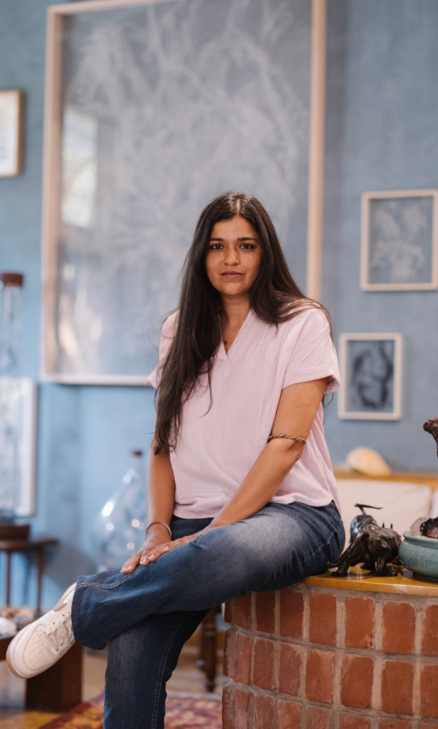
Representing India at the Venice Biennale 2026, New Delhi-based artist Sumakshi Singh explores time, memory, loss and space through fragile thread installations that uncover the emotional traces embedded in architecture. Her work transforms delicate materials into meditations on absence, presence and the passage of time.
Sumakshi Singh’s practice unfolds in the delicate space between presence and absence, materiality and memory. For over two decades, the New Delhi–based artist has explored the shifting relationships between space, time, perception, and belonging through drawings, and her evocative thread-based installation. Working with fragile and ephemeral materials, Singh transforms the intangible into the tactile, creating immersive environments that invite viewers to reflect on permanence, loss, remembrance, and the invisible traces that shape our lives.
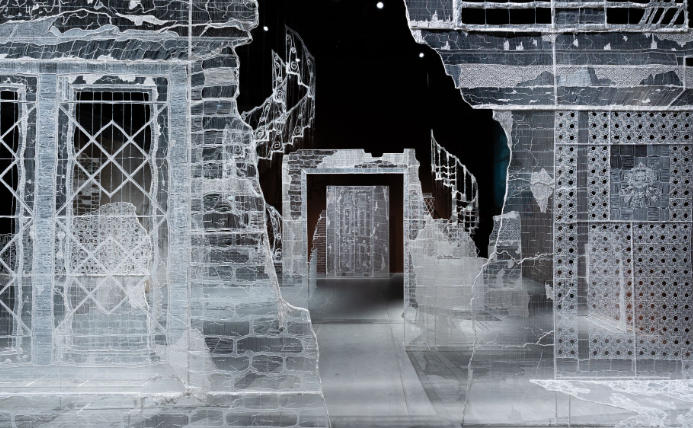
Moving between architectural forms, personal histories, and imagined landscapes, Singh’s practice reflects on how we experience the world and preserve what cannot be held onto. Rooted in intimate narratives yet resonating universally, her works evoke a quiet emotional intensity, asking profound questions about home. Her deeply personal yet universally resonant work ‘Permanent Address’, presented at the India Pavilion at the Venice Biennale 2026, explored the emotional architecture of home through an installation that blurred the boundaries between memory, absence, and lived experience.
Singh has designed the renowned windows for Hermès, India and has mentored residencies for The Victoria and Albert Museum, The Why Not Place 2010 and 2011, and curated for the Devi Art Foundation. She is the recipient of several awards, including the Asia Arts Future Game Changer award by the Asia Society in 2022, the YFLO award from the Federation of Indian Chambers of Commerce & Industry in 2019 to name a few. Her work has been exhibited in more than 20 solo exhibitions and over 100 curated group exhibitions across leading galleries, museums, and institutions worldwide, cementing her position as one of the most compelling voices in contemporary Indian art.
In this conversation, Singh reflects on the evolution of her visual language, her intuitive relationship with materials, and the questions that continue to shape her artistic journey.
Sumakshi speaks to Blur The Border :
Blur: How has your artistic or creative style evolved over the years, and how do you view this evolution?
Sumakshi: Over the years, my relationship to ideas has shifted from pursuing what seems interesting to following what feels necessary. Rather than chasing every compelling idea, I am drawn to questions that demand sustained attention and working with greater focus. My earlier works were shaped by place, history, and context, examining the ways we construct and navigate the world around us. Through site-responsive projects, anamorphic drawings, and investigations into urban landscapes, I questioned the apparent stability of reality and the systems through which we perceive and organize it. More recently, this inquiry has turned inward. While the underlying questions remain the same, the work now focuses on the inner landscapes of memory, longing, belonging, and impermanence. Seen in retrospect, the evolution of the work feels less like a change in direction than a gradual movement toward the more intimate dimensions of questions that have always guided my practice.
Blur: Do you have a definitive process while creating? Are there any habits or rituals that help you get into a creative mindset?
Sumakshi: Showing up to the studio day after day is the real ritual. Each project asks for something different. There is no fixed process. It's more about entering a state of mind that allows me to sit comfortably in uncertainty—to listen closely, moment by moment, for where a line wants to go, what a material wants to become.
I often arrive in the studio with an impulse to explore a feeling that I can sense but not yet define. There is then an impulse to pick up a particular material. If I stay with it long enough, the work gradually reveals what it is trying to explore. For me, creative practice functions a bit like an antenna - it tunes into things that need to be brought into awareness, things the conscious mind may not yet have language for. In the process of shaping something externally, something internal also begins to shift and transform.
Blur: Thread and architectural forms recur throughout your practice. What draws you towards this medium and subject?
Sumakshi: Thread entered my work through embroidery, a practice I shared with my mother. After her passing in 2013, I began tracing her handwritten letters she had sent me and stitching her words into fabric. What drew me to embroidery was its permanence. By dissolving the fabric support, the embroidery itself became the structure, suspended between presence and absence.
This process evolved into large-scale thread gardens and architectural works, including a response to the demolition of my family home at 33 Link Road in Delhi. Rendered entirely in thread, these works explore memory, loss, belonging, and the fragile ways we hold on to places and people after they have disappeared.
Blur: Reviewing about two and half decades of your practice, what concerns have remained constant for you?
Sumakshi: Across two and a half decades of practice, my core concerns have remained remarkably consistent: space, time, perception, memory, impermanence, and transformation. While my work has evolved from examining physical, social, and perceptual spaces to exploring more internal landscapes of memory and longing, it continues to investigate thresholds—those unstable in-between states where boundaries blur and multiple realities coexist. At its heart, my practice is driven by an interest in how we experience the world, navigate change, and seek continuity amid transience.
Blur: In a moment of rapid change, what is one question you're sitting with — or one you think our community needs to reflect on and discuss more openly right now?
Sumakshi: I keep returning to the question of what endures in a world defined by change. My work reflects on what we choose to preserve - our stories, memories, relationships, and identities—while recognizing that absence does not always mean erasure. What disappears physically can continue to exist through memory, culture, and lived experience. I am interested in how we honour what is lost while allowing it to transform and continue shaping us in new ways.
Blur: If you were to collaborate with another artist — within or outside your discipline — what is one collaboration you would love to explore?
Sumakshi: I would love to collaborate with a classical Indian musician. Much of my work exists in a space between the material and the immaterial - it has physical form, yet often feels ephemeral, as though it is hovering between presence and absence. I think sound operates in a similar way. It emerges from silence, takes shape for a moment, and then dissolves back into it.
Know more about Sumakshi:
Website: https://sumakshi.com/
Instagram: @sumakshisingh
Writer : Urvi Kothari
Know more about Urvi Kothari: @urvi_kotharii