Gallery Maxima
Mumbai
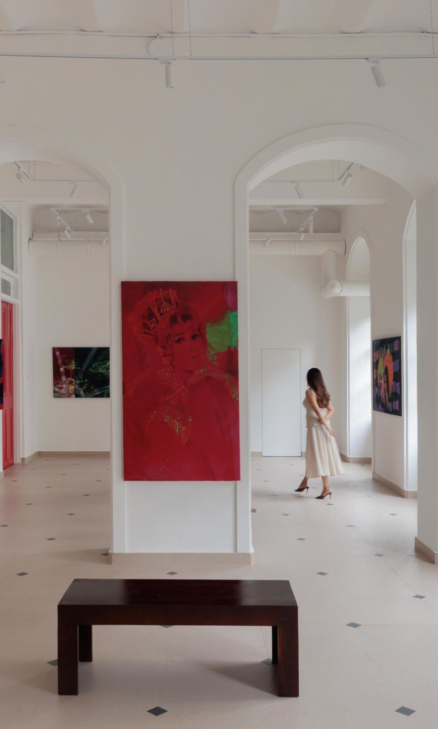
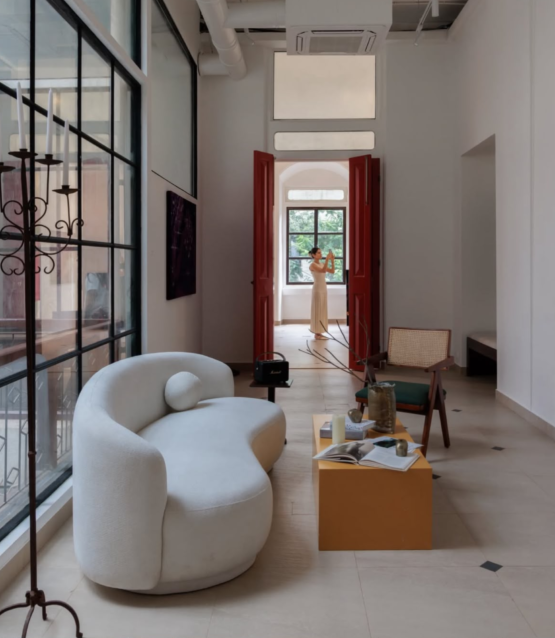
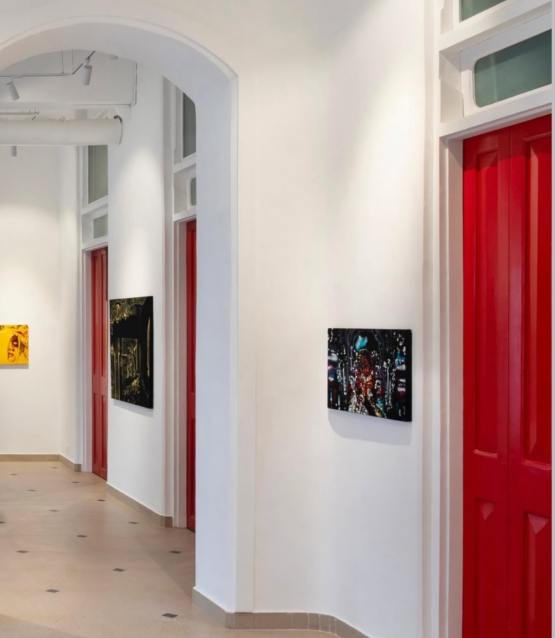
Fort has always carried its history close to the surface, and Gallery Maxima settles into that texture rather than working against it, choosing to root itself inside a building the city has already lived in for over a century. Set within the historic Kitab Mahal in Fort, the gallery occupies a 1,600 sq ft second floor space that quietly resists the polish of a typical gallery box. Arched thresholds, curved windows, original stone flooring and high ceilings retain the material memory of old Bombay, offering a textured, layered backdrop for contemporary exhibition making rather than a blank one waiting to be filled. The first thing to catch the eye on arrival is the door itself, painted a bright, almost defiant red against the building's aged stone and timber, a small jolt of colour that announces exactly what the gallery is trying to do: let the historic and the contemporary sit in the same frame, each one sharpening the other rather than competing for attention.
What sets Maxima apart, beyond its walls, is the intention behind its programming. Conceived as a platform for sustained engagement between artists, audiences and collectors rather than a rotating door of one off shows, the gallery focuses on contemporary practices emerging from South Asia and its diaspora. Its curatorial lens foregrounds material inquiry, cultural memory, lived histories and evolving regional narratives, paired with a long term commitment to nurturing emerging and md-career artists rather than chasing whichever names the market currently favours. That patience is rare in a city where gallery calendars often move faster than the work itself has time to settle.
The gallery is founded by curator and arts professional Sunaina Rajan, whose curatorial vision draws from years spent across some of the country's, and the world's, most respected institutions, Chemould CoLab, Nature Morte, The Art Institute of Chicago and the Museum of Art and Photography in Bengaluru among them. That range of experience, moving fluidly between Mumbai's gallery circuit and international museum contexts, positions Maxima within both local and global conversations from its very first show, rather than treating either as separate from the other.
That first show, Dream Girl, is the solo debut of Mumbai based artist Maithili Chaturvedi, on view from late June through the first week of August. Chaturvedi is only twenty-three, and that fact matters here beyond biography: it is the distance of a much younger gaze looking back at women whose images were fixed in the popular imagination decades before she was born that gives the work its friction. Velvet, a surface tied to kitsch, nostalgia and old world glamour, is itself an unconventional choice of canvas for an artist this early in her practice, and it is exactly the kind of curatorial risk Maxima says it wants to house, work that arrives with a fully formed point of view rather than one safely derivative of what has already sold. A series of oil paintings on velvet, the exhibition revisits the enduring imagery of iconic Hindi film actresses, Hema Malini, Rekha, Madhubala, Helen, Meena Kumari and Parveen Babi among them, faces that have long lived somewhere between memory and myth in the Indian imagination. Rather than indulging in nostalgia, Chaturvedi's works probe the construction of femininity and stardom itself, navigating the space between spectacle and intimacy, fantasy and lived experience, using velvet's own history as a surface of glamour and kitsch to complicate rather than simply celebrate the icons it depicts.
Through its opening, Gallery Maxima signals more than the arrival of a new exhibition space in a city that already has plenty. Situated in one of Mumbai's most historically layered cultural districts, at a moment when Fort and its surrounding lanes are witnessing renewed energy around artist led experimentation, critical programming and expanding collector engagement, the gallery adds itself to the neighbourhood's ongoing role as a vital node for artistic and intellectual exchange. It is a new room built inside an old one, asking the city, and everyone who walks through its arched doorway, to look again at both.