Gujral House
Delhi
A house that has been lived in for decades carries a different weight than one built to be looked at, and Gujral House in Lajpat Nagar was always the former before it became the latter. Originally conceived by architect Raj Rewal and later reshaped by artist and architect Satish Gujral himself, the unclad red brick structure has spent as much time evolving as standing still. What opens to the public now is not a preserved monument but a home that once welcomed artists, writers, musicians and architects as regular participants in the life inside it, restored in 2025 by Gujral's son, architect Mohit Gujral, and now stewarded by the Gujral Foundation.
That distinction between monument and home shapes everything about how the space is being used. Rather than freezing the house into a static shrine, the current programming treats architecture as a continuum of Gujral's broader artistic practice, painting, sculpture, mural and muralism, all extensions of the same instinct that shaped this building. The house becomes both an archive and a framework, revealing how a man who worked fluidly across disciplines treated space itself as a response to the life he was living at the time, thresholds, corners and pauses given as much consideration as any canvas.
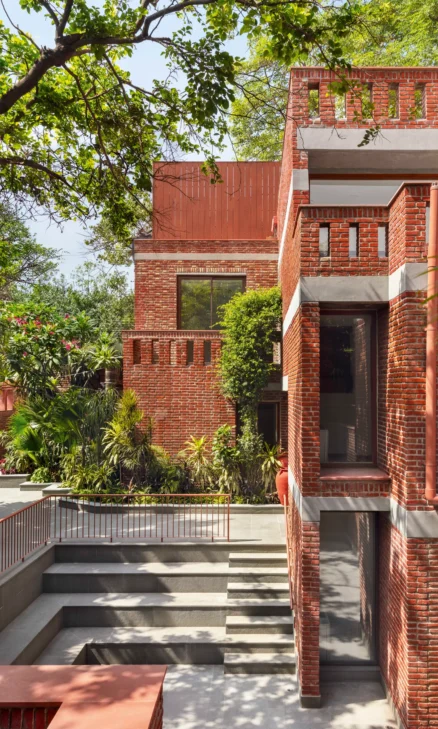
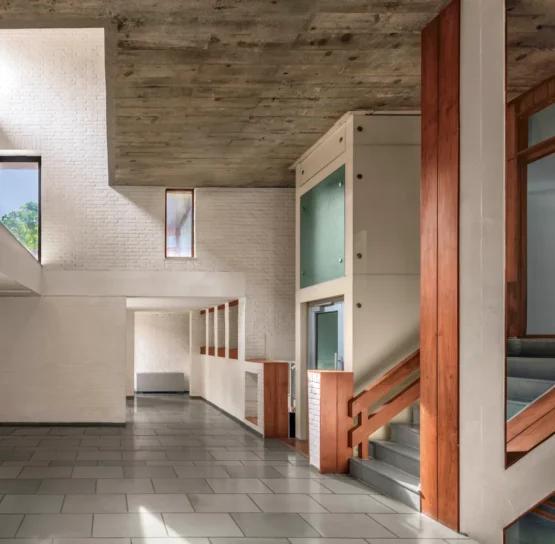
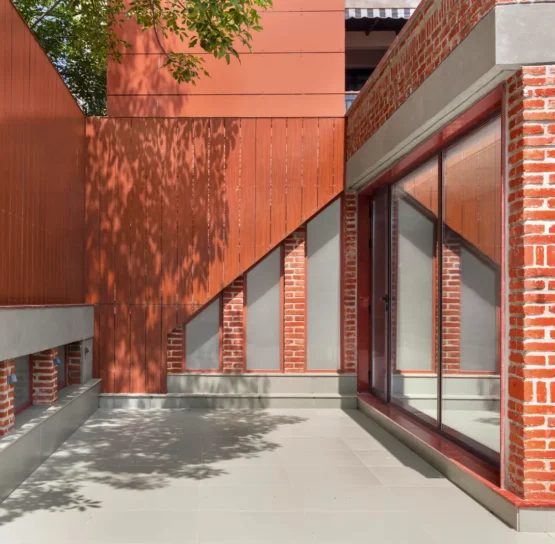
Satish Gujral's own path to architecture ran through rupture first. Born in Jhelum in 1925, his early life was shaped by partition and a hearing impairment that sharpened an inward attention he carried into everything he made. Time in Mexico in the early 1950s, apprenticing under Diego Rivera and David Alfaro Siqueiros, introduced him to muralism as a public act, an influence that later shaped his mosaic work and his architecture, including the Embassy of Belgium in New Delhi. 2025 marked Gujral's centenary, and Gujral House now runs a curated exhibition of his architectural thinking, curated by Rhea Sodhi, with key programming and curatorial direction led by team members like Alaiia Gujral, alongside a parallel retrospective of his broader practice at the National Gallery of Modern Art. Where the NGMA show traces seven decades of material and surface across his paintings and sculpture, the exhibition inside Gujral House stays closer to the domestic, using the building itself as evidence of how Gujral inhabited his own ideas rather than simply illustrating them on a wall. During the India Art Fair, the house extends further still, hosting architecture and design exhibitions, talks and satellite events inside the same red brick walls that once held dinner parties and studio sessions. Together, the house and its programming resist the kind of closure a retrospective usually implies. Rather than looking backward in reverence, Gujral House insists that legacy, like space, stays alive only for as long as it continues to be inhabited, asking every visitor who steps through its unclad brick doorway to treat the house the way its original occupant once did, as something still being lived in, not simply looked at.
Address: 16, Feroze Gandhi Rd, Block I, Lajpat Nagar III, Lajpat Nagar, New Delhi, Delhi 110024, IndiaBook Walking Tours