House of Agam
A contemporary clothing label rooted in Tamil Nadu, drawing from South India’s climate, textiles and cultural language. Working with breathable materials and relaxed silhouettes, the brand brings traditional references into a contemporary wardrobe through a focus on material, form and everyday functionality.
House of Agam is a contemporary clothing label based in Tamil Nadu, drawing from the materials, climate and cultural history of South India to create clothes for everyday use.
Fabrics are chosen for breathability, movement and how they change with wear. Organic cotton, linen, bamboo and Tamil Nadu-grown Suvin cotton appear across relaxed shirts, polos, dresses, trousers and everyday separates. The silhouettes are easy, while construction and finishing remain precise.
House of Agam takes its name from the Tamil word for the inner self or interior. This idea carries into the clothes, where cultural references are expressed through fabric, form and construction. The Ōlai collection draws from the lines of South Indian palm-leaf manuscripts, while Karu, meaning “core,” brings together staples designed for regular and lasting wear.
The garments are developed and produced in-house, giving the brand greater control over fabric, fit and finishing, from the initial idea through to the final piece.
House of Agam presents a clear view of contemporary South Indian design. The clothes respond to the region’s heat, pace and visual culture without treating heritage as decoration. Designed for long days and repeated wear, the emphasis remains on comfort, material and useful detail: well-made clothing that feels current while staying closely connected to where it comes from.
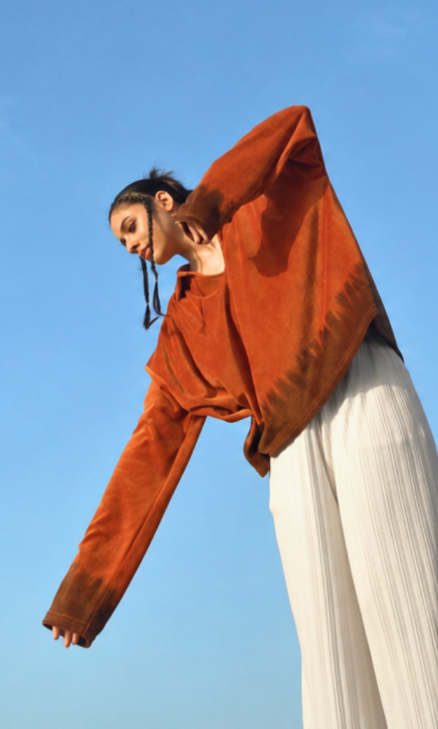
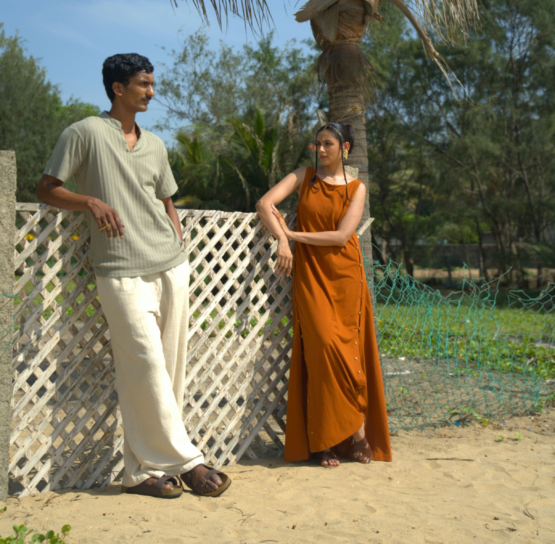
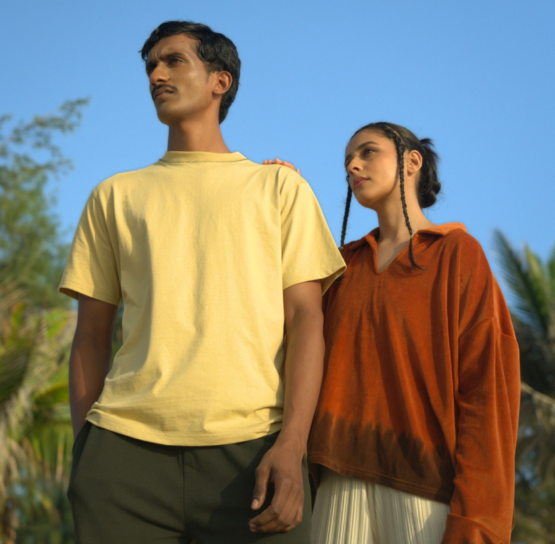
House of Agam speaks to Blur The Border:
Blur: House of Agam is “born in Tamil Nadu,” and you've spoken about heat, humidity, monsoon, and movement shaping your design choices. How does that South Indian climate translate into actual decisions around fabric, fit, and construction?
House of Agam: For us, climate is a very practical starting point. Growing up in South India, we have an instinctive understanding of what it means to dress through heat, humidity, monsoon and constant movement. That naturally influences our choices around fibre, fabric weight, breathability, fit and construction. We want the clothes to feel considered and elevated, but also genuinely comfortable and functional for the environment they are being worn in.
Blur: Your logomark and design language draw on the Makara, a motif rooted in South Indian temple architecture, traditionally seen guarding thresholds. Why did that symbol feel like the right one to build the house around?
House of Agam: The idea of a threshold felt very relevant to what House of Agam is trying to do. The Makara has this beautiful association with guarding an entrance, and for us, it represents a movement between what is inherited and what is contemporary. We are deeply rooted in South India, but we don’t want to simply recreate familiar expressions of the past. We want to draw elements from our cultural landscape and reinterpret them in a way that feels relevant to how we live and dress today.
Blur: Alongside the Makara, you've also worked with kolam-inspired patterns drawn from ritual and textile traditions of the South. How do you translate something as regional and specific as a kolam into a contemporary garment without it reading as costume or cliché?
House of Agam: We try to look beyond the obvious visual representation and understand what makes the reference interesting in the first place. With kolam, for example, it is the geometry, rhythm, repetition and continuity that we are drawn to. We create subtle kolam-inspired glyphs as unique markers for each collection, translating these qualities into a more restrained, more abstract form. The idea is not to reproduce the kolam, but to let its underlying character inform the way we design.
Blur: You describe your process as material-led rather than sketch-led, starting with fibre and texture before form. What does that actually look like in practice, and how does South Indian textile and manufacturing knowledge feed into it?
House of Agam: We often begin by understanding the material first - the fibre, yarn, texture, weight and how it behaves on the body. We experiment with what it can do before deciding exactly what the final garment should look like. South India has such a deep understanding of textiles and manufacturing, and that knowledge becomes an important part of the process for us. We are interested in taking that existing expertise and pushing it into new forms and applications.
Blur: How do the Ōlai and Karu collections speak to each other? Is one an entry point into the other, or are they solving different problems for the wearer?
House of Agam: They are different expressions of the same House. Karu is really about building the foundation of an everyday wardrobe - quiet, versatile and considered pieces that can be lived in. Ōlai allows us to explore our cultural references and storytelling in a more conceptual way, drawing from the visual language and history of palm-leaf manuscripts. They approach clothing differently, but both are about creating a contemporary wardrobe with a strong sense of where it comes from.
Blur: Beyond House of Agam, where do you see the biggest opportunities and gaps in South India's textile and manufacturing ecosystem right now, and is there anything the wider industry could build or fix collectively?
House of Agam: South India already has an incredibly strong textile and manufacturing ecosystem, but there is a lot of knowledge that remains fragmented. At House of Agam, we believe there is a real opportunity to create stronger connections between designers, manufacturers, artisans, mills and newer technology. There is also a need for more documentation and investment in experimentation, so that traditional knowledge doesn't just get preserved, but continues to evolve and remain economically relevant.
Blur: You take techniques rooted in South Indian craft and combine them with methods from elsewhere. How does that research and translation process work for you, and what guides which techniques you choose to bring together?
House of Agam: It usually starts with curiosity, we look at what a technique brings to the material, product and concept - its texture, movement, process or history - and then explore how that can work with another technique or context. We don't see craft as something that has to remain fixed within its original form or geography. For us, the interesting part is seeing how these techniques can evolve through experimentation while still retaining a sense of where they come from.