Jobner
Rooted in Rajasthan yet shaped by a wider study of material, culture and identity, Jobner approaches jewellery as an expression of taste and personality rather than ornament alone.
Founded by Jitesh Gupta and Radhika Sharma, Jobner is a jewellery label from Jaipur, shaped by the city’s long relationship with gemstones, craft and architecture. The brand works with these references to create contemporary pieces that remain connected to their cultural and material origins.
This direction reflects the founders’ different backgrounds. Gupta grew up in Jaipur and developed his understanding of gemstones through his family’s trading business. Sharma’s interest in language, identity and regional culture informs the visual language of the label. Their combined perspectives allow Jobner to treat jewellery as both an object of adornment and a way of examining how design moves across places and periods.
The process begins with research into jewellery, architecture and decorative arts. Each piece is then handcrafted by artisans in Jaipur using techniques passed down through generations. Strong forms and detailed stone settings give the jewellery a distinct presence while keeping the focus on material and construction.
Across its collections, Jobner brings Indian and European influences into conversation. Renaissance explores the artistic connections between Mughal India and Europe, while Baroque draws from European, Mughal and Persian design. Vocabulary looks more closely at Rajasthan, translating geometric and architectural forms into wearable objects.
Rather than reproducing a particular period, Jobner selects ideas from different sources and places them in a contemporary context. Its jewellery reflects a layered history of cultural exchange, expressed through proportion, colour, form and technique. The result is detailed and expressive work that feels rooted in Jaipur while remaining open to a broader visual world.
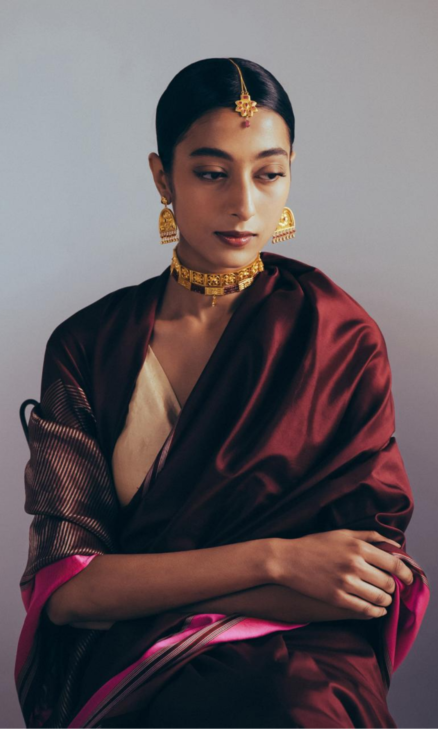
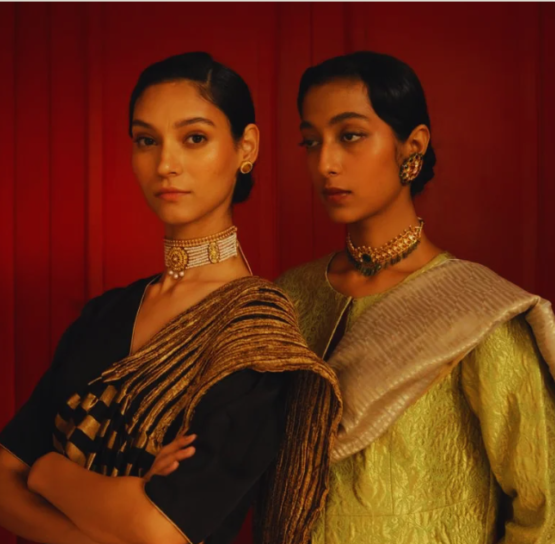
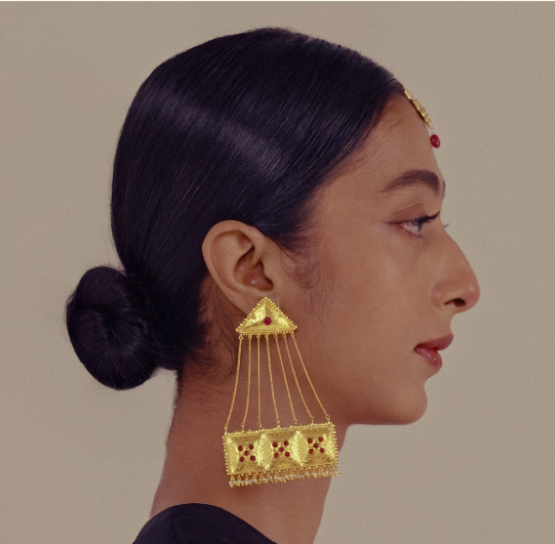
Radhika and Jitesh speak to Blur The Border :
Blur : Jitesh, you bring two decades of gemstone trading experience across Africa, while Radhika’s background is rooted in language, identity, and aesthetics. How do two such different vocabularies actually merge into one shared design language at Jobner?
Radhika and Jitesh : What we love about the gemstones is that every gemstone has its own character. Our approach towards gemstones is beyond using it only as a material application we are interested in treating them as visual motifs each carrying it own colour, form, texture and personality. In this sense, our work invites a dialogue around taste, perception and lifestyle. This process allows us to move beyond jewellery as an immediate, tangible object, towards something more personal, an extension of one’s personality, sensibility and way of seeing.
Blur : Jobner is named after a real town in Rajasthan, rather than an invented word the way most jewellery labels are named. What made you choose to root the brand’s identity in an actual place rather than a coined name?
Radhika and Jitesh : At Jobner we wanted to have a version that is real portrait of the world around us, faraway from the general lens through which everything is observed. A reality that is grounded and breathes through its own sensibilities. The intent was to have a grounded real reference for sensibilities, and never a fabricated idea of a fictional place.
This also informs our own set of sensibilities, of how a place that is part of a larger landscape, exists in its own innate quality, giving the true character of the region.
Blur : Your material describes distilling every influence down to the “Saar” — the essence. In practice, what does an idea have to lose before you’d call it distilled down to its Saar, and how do you know when you’ve gone too far and lost something that mattered?
Radhika and Jitesh : The process starts by observation, and acknowledging, how years of material culture, influences, cultural footprints and behaviours have informed the world around us. This is how the idea is looked at, a collective of many world’s interacting with each other. An attentive gradual process of knowing each layer, helps in articulating the ‘saar’.
Focusing on just one layer, is moving away from ‘saar’. By being more conscious of how a style has embedded itself in an object, provides an insight into the minds of people from that time, and their world.
Blur : Fine jewellery in India is often either purely traditional or purely Western in its influences. Who do you see as the Jobner customer, and what are they looking for that they can’t find elsewhere?
Radhika and Jitesh : As Jobner customer, we get propelled by personalities that are original with their own point of view and sense of self.
Our consumers are propagated by their own derivations and meanings of taste and sense of value. They do not subscribe to borrowed conventional definitions. A Jobner buyer, invests in their own expression beyond anything else.
Our immediate references the versatility of Maharani Gayatri Devi, nudges how one person can re-present to each occasion in their own innate ways. In that sense, we feel style is not limited to singular expression, and is a reflection of taste.
Blur : Since 2022, Jobner has presented everywhere from Conscious Effort Hyderabad and Qala India Indore and towards The Silk Root in Singapore and Bykanjj in London. How differently do audiences respond to the same piece depending on where you show it?
Radhika and Jitesh : Across different regions there have been factors through which people interpret ‘jewellery’ often culturally, religiously and as investment; lately people have shared resonance in approaching it as an element to convey their personality. This is something, that excites us, how a small object adds layers of characterisation to an individual.
In India too, there has been an emerging appreciation of natural gemstones, where value is not compromised at the expense of affordability.
Blur : You’ve said history is treated “as a source of knowledge rather than imagery,” so meanings are translated rather than replicated. Can you walk us through a specific instance where the easy choice would have been to copy a historical motif directly, and what you did instead?
Radhika and Jitesh : With Jobner, the interest lies in the larger realm, of how elements, styles, motifs are all a result of cultural movement over the years, borrowed, transported and transferred.
Like our Borkunda earrings, where the source origin was a window from a haveli, the conventional route would be to trace the outline; we were immediately interested in how the proportions of the window was uniquely original. Upon further study, we realised the ratios were at the heart of it. It is from these ratios that Borkunda was realised.
This is the larger sensitivity we approach our subjects with, through historical references and our design process of collections with the same methodology.
Blur : Jobner is built around the two of you and how your instincts meet. How do you know when an idea is authentically “Jobner,” especially when you don’t agree at the start?
Radhika and Jitesh : Between us, we often find ourselves in two shoes, interchangeably. Dreamer and a realist, that nudge conversations, that eventually help us articulate Jobner everyday better. This also creates perspectives in knowing how things can be, and what we are not. In that sense, this dialogue is what moves Jobner ahead. Simmering our philosophies slowly.
We are also in the process of sculpting ‘Jobner’, since we started with jewellery, a definitive form is still brewing constantly being informed by the behaviours and ways that people perceive tangibles.
Blur : What’s next for Jobner — the next “study,” collection, or direction you’re most excited about?
Radhika and Jitesh : The palette of various media is fascinating, coming from Rajasthan, where the palette of moving image, literature, poetics, music and objects have all played a part in forming the region’s sensibilities, we wish to explore this too. This experience is intended to be shared across different cities, introducing people and evoking them to world of Jobner.