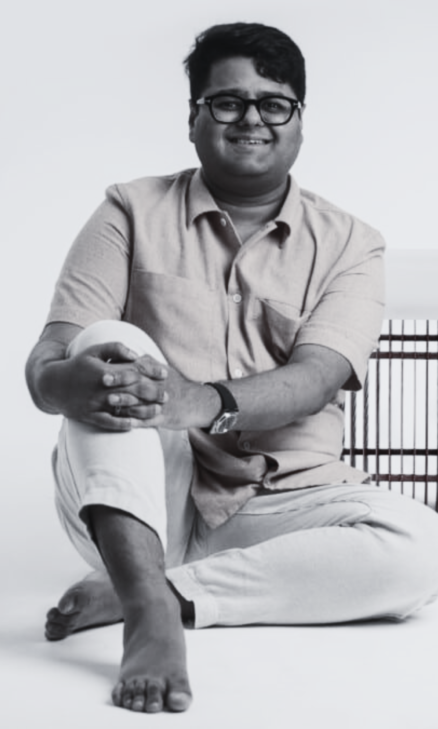
Dhruv Agarwwal
A designer whose work bridges art, craft and contemporary design, he transforms India's traditional materials and cultural motifs into large-scale sculptural installations that celebrate heritage while inviting new conversations across cultures.
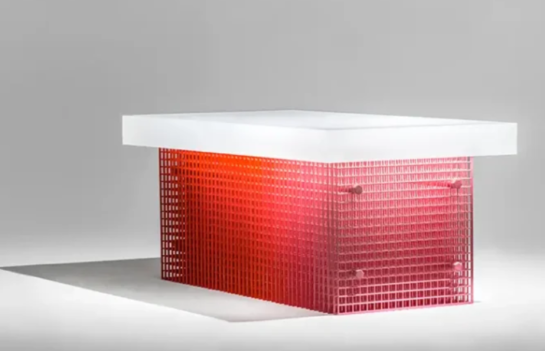
In Dhruv Agarwwal's work, Meenakari details, Channapatna toys and glass bangles are transformed into large-scale sculptural objects through the use of materials including acrylic, steel and LED technology. Straddling the worlds of art and design, the contemporary and the traditional, the Delhi-based designer draws from India’s shared cultural memory, reassembling them into forms that feel at once recognisable and entirely new. Through scale and lending an experimental lens to the heritage of Indian craftsmanship, he creates works that instantly become visual anchors of their surroundings. It is a perspective informed by a global outlook and a desire to foster cross-cultural dialogue, one that has since found resonance beyond India through his representation by Paris-based Galerie Maria Wettergren. The experience of standing before one of Dhruv’s sculptures often begins with pure visual delight. The vivid colours, bold contrasts and intricate details draw the eye in immediately, moving across the work as you begin to take in its many layers and nuances. Once the initial visual impact settles, the familiar materials and craft references might remind you of childhood, cultural memories, traditions, or experiences you have encountered before.
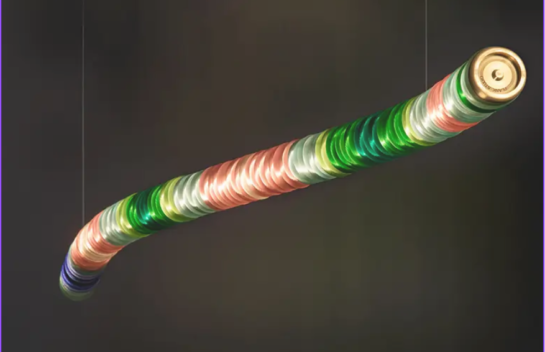
It is a quality that surfaces repeatedly throughout his work. Take Rangeela (2023), for instance, where hand-cut glass bangles crafted by the revered artisans of Firozabad are arranged on acrylic and illuminated from within through LED technology. Then there is Full Bloom (2020), a larger-than-life chandelier inspired by the visual language of Rameshwaram temple ceilings and the channapatna bead tocken of chaupar. Reimagining these symbols of play and heritage at an architectural scale, its playful geometry and saturated colours transform childhood nostalgia into a luminous contemporary object. The presence of craftspeople within these works is far from incidental. His partnerships with the artisans of Firozabad, Channapatna and beyond are not isolated instances. If there is one thread that binds much of Dhruv's oeuvre together, it is collaboration. With projects spanning both the public and private spaces, he has created works of art alongside artists and craftsmen from different regions of the country. A graduate of Pearl Academy of Design, Dhruv belongs to a generation of designers increasingly challenging the binaries that once defined creative practice. His work does not treat the traditional and the contemporary as opposing forces; instead, it allows them to coexist with remarkable ease. In many ways, his sculptures feel emblematic of the moment we inhabit—one where heritage and innovation, the analogue and the digital, nostalgia and progress are constantly finding new points of intersection.
Blur: Your works often evoke a sense of eclecticism, joy, and a kind of visual exuberance. What informs this aesthetic, and where does this inclination toward playfulness come from?
Dhruv: I think the joy in my work is often the first thing people notice, but for me it is not just decorative. It is a way of drawing people in.
I come from a visual culture where things are rarely minimal in the strict sense- markets, temples, homes, festivals, domestic rituals, even everyday objects carry a certain density. I absorbed that very naturally while growing up. What interests me now is how that visual abundance can become contemporary without losing its emotional charge. The playfulness in my work comes from memory but also from a desire to make familiar things feel strange and precious again. So when someone reads the work as exuberant I see that as an entry point. Beneath that surface there is also labour, craft, nostalgia and a quieter search for wonder.
Blur: Has this artistic sensibility always been a part of your practice, or has it evolved over time? If yes, in what ways?
Dhruv: The sensibility was always present but it was not always articulated.
In the beginning, I was responding instinctively to things I had grown up around. I did not see them as a design language then, they were simply part of my world. Over time, especially after working in interiors and then moving into collectible design, I began to understand how those references could be transformed through scale, material and craft. So yes, it has evolved. It has moved from instinct to intention. What was once an emotional pull has now become a more deliberate way of making.
Blur: The merging of traditional crafts and contemporary materials is central to your pieces. In ‘Full Bloom’, for instance, you bring together Channapatna toys, Meena enamel, colours inspired by the chakra paintings of the Rameshwaram temple, along with metal and LEDs. What drives this approach, and what does the process of unifying such diverse elements look like?
Dhruv: What drives this approach is the desire to create objects that hold many kinds of time at once. The challenge is not to make these elements coexist visually, but to make them speak the same language. That takes a lot of editing. I test, remove, simplify and recalibrate until the references are no longer visible as separate ideas. Ideally, the final work should feel inevitable, even if its origins are incredibly diverse.
Blur: Do you follow a defined process when creating? Are there any habits or rituals that help you enter a creative mindset?
Dhruv: I don’t have a fixed ritual but I do have a way of staying close to ideas. Most projects begin as fragments- memories, materials, colours or objects I encounter by chance. I collect these mentally until a connection begins to form. From there, the process becomes very disciplined. I move between sketching, digital modelling, 3D printing, full-scale prototyping and long conversations with artisans. The object is constantly edited through scale, weight, colour and construction.
Blur: Studios today are increasingly becoming spaces of experimentation rather than just production or scale. How do you position your practice within this shift?
Dhruv: I position my practice as a studio of inquiry rather than a studio of output. Of course, objects are produced, but the real work begins before that- when a material, memory, craft technique or ordinary object is pushed into another scale or context. I’m interested in what happens when inherited craft knowledge meets contemporary tools and collectible design systems.
Blur: As more contemporary practitioners explore the intersection of furniture and sculptural design—even within private commissions—the boundaries between art and design continue to blur. How do you see this evolving within the domestic spaces we inhabit?
Dhruv: I think the domestic space is where the boundary between art and design becomes most interesting, because objects are not only looked at there - they are lived with. My own work often begins with familiar domestic or childhood references, but through scale and material they become something more sculptural. I like that shift, where an object remains usable but also asks to be experienced differently.
I see this evolving into homes that are less about perfect decoration and more about emotional landscapes- spaces where objects carry stories, labour, craft and imagination.
Blur: India has no shortage of creative talent, but often lacks the infrastructure to support it. In your experience, what opportunities are being overlooked, and what is needed to build a more cohesive, future-ready creative ecosystem?
Dhruv: We have extraordinary talent and craft knowledge but the systems around them are often fragmented. A designer may be experimenting in one corner, an artisan cluster may be struggling in another and institutions, collectors and galleries may not always be connected to that process early enough. A stronger ecosystem would create bridges between these worlds. It would support prototyping, documentation, critical writing, mentorship, residencies, patronage and access to serious international platforms. It would also allow young practitioners to fail, test and develop before expecting commercial clarity.
India does not need to imitate another creative model. It needs to build one that recognises its own strengths and gives them the infrastructure to evolve with dignity.
Blur: If you were to collaborate with another artist—within or outside your discipline—what is one collaboration you would love to pursue?
Dhruv: I am already in the middle of a collaboration that feels like a dream in many ways- a limited series of bronze objects with the Verhoeven Twins. Their work carries a surreal world of its own and my practice comes from memory, craft, colour and domestic imagination. Bronze gives us a shared ground: it is heavy, ancient, permanent, and yet capable of becoming fluid and dreamlike.
The most exciting collaborations, for me, are the ones where both practices become slightly unfamiliar and the final object could not have belonged fully to either person alone.
Blur: In a moment of rapid change, what is one question you are currently sitting with—or one you think the creative community needs to reflect on more openly?
Dhruv: We live in a time where objects, images and ideas move very quickly but value still moves unevenly. A craft, material or community may carry immense intelligence yet remain under recognised until it is reframed by institutions, galleries or global markets.
I think the creative community needs to reflect more openly on that gap. How do we create visibility without extraction? How do we build aspiration without disconnecting work from its source?
Know more about Dhruv Agarwwal:
Instagram: @dhruvagarwwal