Nikhil Chopra
by: Virender Singh
From the tangled skein of semi-fictional characters, this artist has spun a web of living
performances that engulfs hours, days, and sometimes entire cities.
Nikhil Chopra’s fiery, often charcoal-smeared one-man performances are an astounding spectacle to witness firsthand, matchless in the realm of endurance art. Situating the act of en plein air drawing within site-specific installations, he seems to prise apart the countless gears and hidden machinations that propel history. In one of his most ambitious works, Chopra spent nine days (216 hours) at The Metropolitan Museum of Art in New York, drawing live while embodying a semi-biographical persona. If this sounds faintly unhinged, that's because his practice has always occupied the twilight zone between obsession and revelation, where the body itself becomes an archive. Time glitches, identities blur, and the audience is invited to watch an entire world come to life.
Over the past two decades, this Kolkata-born, Goa-based performance artist and peripatetic storyteller has lived, slept, and created giant canvases that unfold across museums, defunct train stations, historic buildings, and urban landscapes around the world. His multi-day, continuous narrative pieces at The Whitworth in Manchester, Centre Pompidou in Paris, and numerous international biennales and exhibitions are like an uncomfortable encounter with the larger, more sinister forces pulling at the corners of our reality.
Through recurring dramatis personae such as Yog Raj Chitrakar, an aristocratic draughtsman loosely inspired by his grandfather, Chopra pokes a sceptical finger at inherited ideas of masculinity, social privilege, and nationhood. He is an irreverent fabulist, a shapeshifting time traveller who slips through wormholes of collective memory, colonialism, and the sundry corners of his own genealogical obsessions. Paying obeisance to the romantic legacy of long-lost native gentlemen, footloose dandies, and dreamers, he has steadily pushed the limits of performance art, inveigling his way beyond the confines of galleries and into the crucible of public life.
He also moonlights as the co-founder of HH Art Spaces, a homegrown community of visionaries working across performance, visual art, sound, and installation, bound together through what he describes as “economies of friendship”. More recently, he expanded his practice into large-scale curatorial work as curator of the sixth edition of the Kochi-Muziris Biennale, For the Time Being.
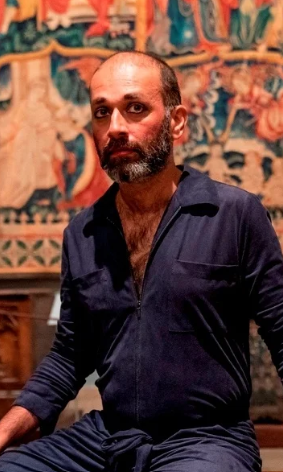
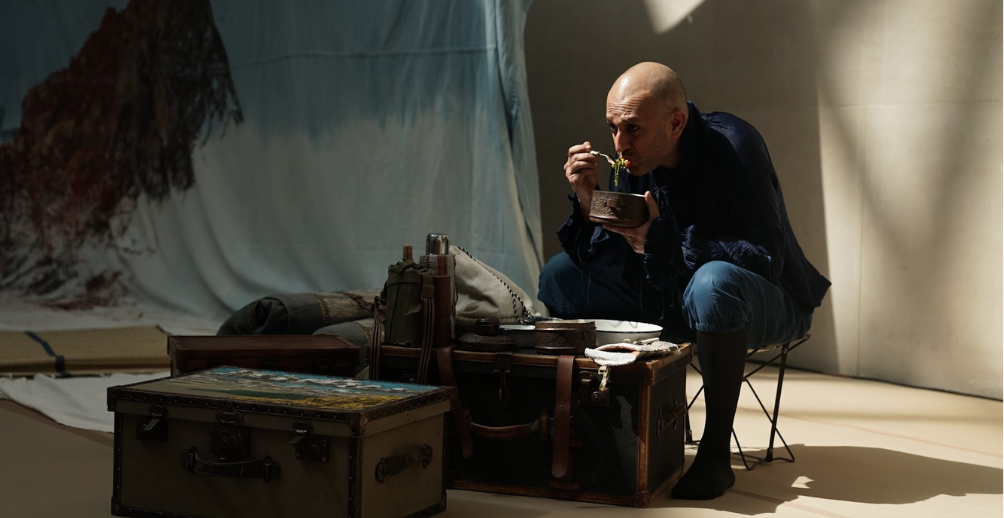
Lands, Waters & Skies (2019) at The Metropolitan Museum of Art, New York. Costume design by Loise Braganza, set design by Michael Vanreusel and production design by Ayesha Punvani. Photography by Shivani Gupta.
In conversation with Blur The Border, Chopra reflects on inhabiting self-fashioned archetypes, and why, after years of moving fluidly between drawing, theatrical transformation, and curation, he still finds himself returning to the cathartic ritual of sketching his fever dreams onto paper.
Nikhil Chopra speaks to Blur The Border :
Blur: How has your creative practice evolved over the years as it has moved between performance, drawing, installation, and now curation?
Nikhil: Art gives you a license for very serious self-critical analysis. It starts there, not with this idea of thinking before doing, but as you do, you think through the doing. So, there were various interests and faculties that I had dipped my fingers into as a young art student. I was, of course, always connected to drawing and painting, but parallel to that, I was also very interested in theatre. That brought about a very different kind of self-reflection. You are stepping into character, costuming yourself, understanding that liminal space of liveness, and the dynamic between performer and audience. When I went for my Master’s (MFA at Ohio State University), I was able to look at the body, live art, performance, and personae as very much part of what a painter can do too. It wasn’t until I returned to India and started my life as an art teacher, where I was talking about drawing as a performative gesture, that I felt like I needed to test this for myself. And Khoj Studios played a very important part when they invited me to a performance art residency back in 2008.
Blur: Do you have a definitive process while creating? Are there any habits or rituals that help you enter a creative mindset?
Nikhil: Yes! Firstly, at least half an hour of silence. And then, as I’m getting older, I need to get a good stretch before I get out there. I’m almost always extremely nervous, and I know that’s never going away. But I like it that way because it keeps my feet on the ground, keeps me humble and engaged.
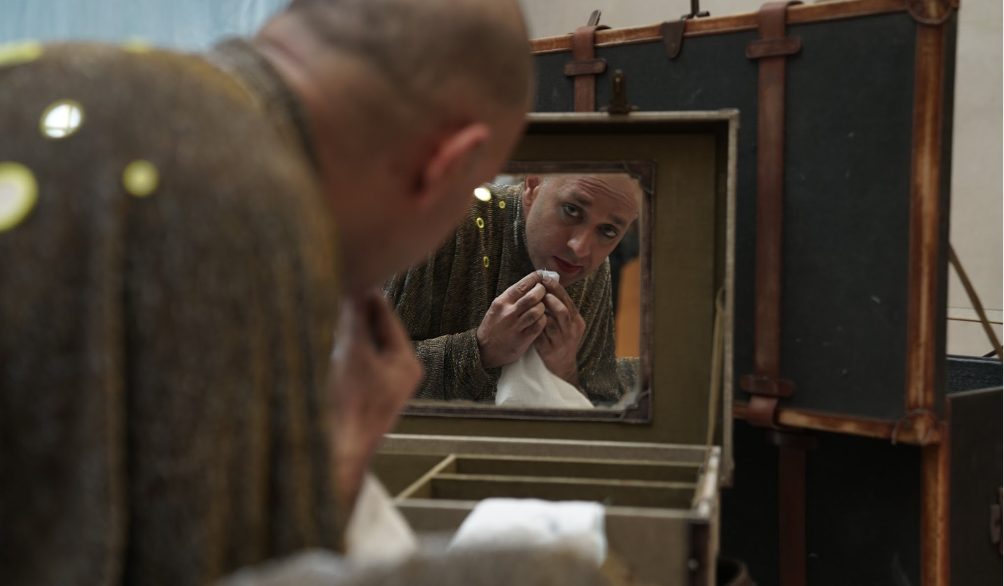
Lands, Waters & Skies (2019). Photography by Shivani Gupta.
It’s very important for me to come out on the other side of the performance unscathed and more energised. I eat well when I’m performing, I sleep well, and I really take care of myself. I always put eyeliner on to feel that journey from the ordinary, regular self to that extraordinary, super self. So, completing a 30-foot painting in six hours may feel impossible for Nikhil, but not for the persona that he inhabits. It’s actor technique, really. The kind of stuff you learn from the endurance work of performance art in the ’60s and ’70s, with Tehching Hsieh, Marina Abramović, Yves Klein, Chris Burden, and all these greats who pushed the boundaries of the extremes the body can be taken to.
Blur: Your enactments often spill into real spaces. What appeals to you about this expansion of performance beyond the studio or gallery walls, and how far are you willing to take it?
Nikhil: In a public space, I realise there’s a heightened sense of performativity. The room seems to vibrate in a very different way than it would in my private studio. By stepping out of myself, I alleviate myself of the responsibility of being “true” to who I am. I get the opportunity to lie. Maybe I’m not as tired as I’m projecting myself to be, or maybe I’m not as masculine, or as effeminate, and all of that is okay. It allows me to embrace things that one would ordinarily call mistakes. There are no wrongs or rights, there is no finished work, it’s always ongoing. But after I’ve spent an exhausting eight hours performing and I’ve been looking forward to that final moment, it’s the act of letting go that becomes key. Letting go of the drawings, letting go of your hunger, your sleepiness.
I find myself making promises about certain aspects of what I do as an artist, but in the very next project, I break all of those promises. Who cares anyway? In the end, we shared a moment together, and that’s the only truth that matters. All the other truths are out the window. The could-have, would-have, should-haves. You have to let them go in order to discover something new.
Blur: What appeals to you about inhabiting such layered, imaginary personae across your performance art?
Nikhil: These personae allow me to problematise my relationship with family history and legacy. My grandfather was called Yog Raj Chopra, so I loosely based the character of Yog Raj Chitrakar in the Memory Drawing series (2007–ongoing) on him. Not really on him, but on the idea of the artist, the painter, the dandy. My grandfather always wore a hat, was always dressed up nicely, a proper gentleman, you know? Very angrez in many ways. These performances allow me to actually beat that, defeat it. Having filthy nails, for example, or eating without washing my hands. Picking up chicken with my fingers instead of using a fork and knife. It’s a kind of catharsis to move through various avatars and allow an avatar you’ve invented to take birth. It becomes a way to reclaim that colonial history. To reset the dial.
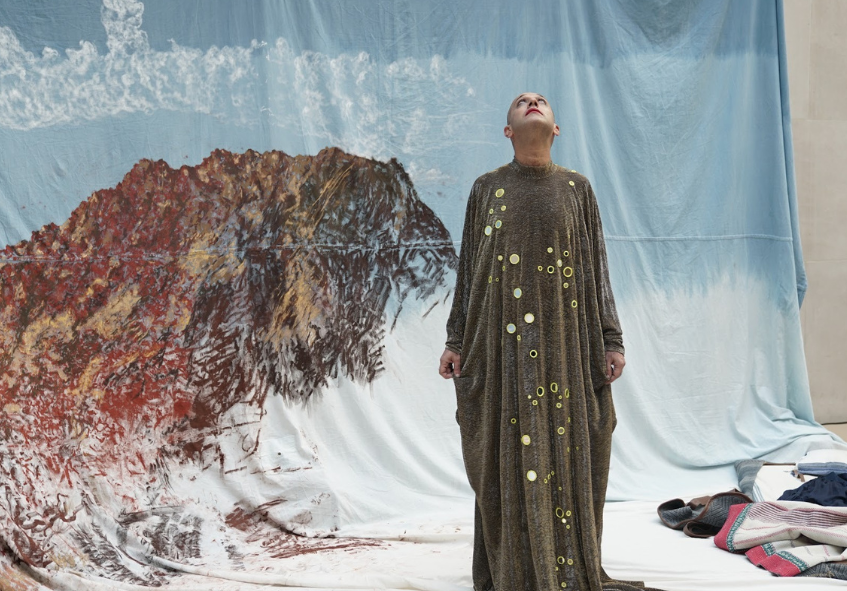
Lands, Waters & Skies (2019) at The Metropolitan Museum of Art, New York. Costume design by Loise Braganza, set design by Michael Vanreusel and production design by Ayesha Punvani. Photography by Shivani Gupta.
Blur: Do you see a signature thread or recurring theme across your performance art?
Nikhil: There are certain strains of investigation that start off with one performance, and then there’s a need to discover something further in the next. For example, through Lands, Waters & Skies (performed at The Metropolitan Museum of Art in September 2019), I moved through the three elements that drove much of my performance work during that period. And then recently, in Fire x Fire (performed at Gare du Nord, Paris, in October 2024), there was a way of reflecting on my work through a slightly more political lens. I mean, global warming first began when we decided to harvest the energy of the sun by striking pieces of wood together. But that is also intrinsically what makes us human: that we’ve been able to commune around fire, tell stories, play with shadows, and narrate our relationship with the cosmos.
Blur: In a time when so much is changing rapidly, what is the one question you find yourself returning to, or one you think the broader creative community needs to reflect on more openly right now?
Nikhil: I think it’s really important to reflect on the relevance of large-scale exhibitions and to understand their impact. What the Kochi-Muziris Biennale does very successfully, and what reassures me that there’s still space for art in the public domain, is its tremendous outreach. There’s obviously a lot of big money involved in putting art out there, and I’ll tell you that it wouldn’t be possible without billionaires and philanthropists. But the perspective should remain that when cities get taken over by large-scale exhibitions, we are working with the city and not in spite of it.
For friendship ecologies to work, we need to take art to people who may not have had the privilege of witnessing work of such quality or calibre before, and the Biennale cannot remain only for the glitterati. It has to become an amalgamation of civic responsibility, cultural vibrancy, livelihood sustainability, and the nurturing of a new generation of critical thinkers. There needs to be a discursive space that allows people to enter, as opposed to alienating them.
Blur: If you were to collaborate with another artist (within or outside your discipline), what is the one collaboration you would like to explore?
Nikhil: I would love to do a performance/cinema project with Björk, Laurie Anderson and Miles Davis!
Blur: How do you sustain HH Art Spaces as a practice built on “economies of friendship” while also building something that can grow and hold space for many opinions?
Nikhil: I don’t really subscribe to this very Western model of constructing the idea of an artist, this sort of existential burden of “my idea, my project.” While I understand that the very nature of my practice is a kind of extended self-portraiture, I also acknowledge the various people who come together to make any performance happen. But sometimes, it can get difficult for me to take it out of the authorship of Nikhil. That’s why HH Art Spaces became an entity of its own, where it was not about Nikhil Chopra, but the idea of a community coming together to make something happen. You can see this even in the Biennale. At that scale, with those kinds of high stakes, I needed to have a support system, people who had my back and would share the responsibility with me, which is why HH very organically entered the mix.
Blur: What are you excited about next?
Nikhil: Alone time. Inward time. Drawing. Meditation. I want to get back to my studio in Goa. I just want to feel charcoal rubbing against paper. I need to digest this Biennale; it’s been very full-on. I need to sit quietly and listen. Hopefully, when I’m ready to put myself out there again, whether as an artist or a performer, I’ll be coming to it with a renewed sense of urgency.
Know more about Nikhil here:
Website: www.nikhilchopra.in
Instagram: @nikhil.chopra.artist
Written by: Virender Singh