Priyanka Shah
For Priyanka Shah, an object is never defined by function alone. At SHED, her multidisciplinary design practice, wood, clay, stone, glass and metal are shaped into sculptural forms that move between art, craft and utility. Each piece begins with attentiveness to material: its grain, weight, texture and the possibilities revealed through making.
Trained in architectural design at Parsons in New York, Shah returned to India in 2014 and developed a practice that brought mechanical precision into conversation with the knowledge of the hand. Working closely with makers, she approaches production as a process of testing, refining and responding, one in which traditional skills are not simply preserved but allowed to evolve.
Shah’s work begins with familiar objects—tables, cabinets, game boards and vessels—then shifts their proportions, materials or mechanisms until they invite a new encounter. Play and movement often enter the process, lending substantial forms an element of surprise. Rather than concealing how something is made, she allows construction, joinery and the character of each material to shape its final expression.
Her work has been featured at the India Pavilion at London Design Fair, GallerySKE, Pulp Society in New Delhi, India Art Fair and the Asian Civilisations Museum in Singapore, as well as by Homo Faber. Now based in Amsterdam, she is expanding the practice through Out of Shed shop, a new platform for ready-to-buy objects. Her work proposes a deliberate rhythm, asking us to recognise the time, memory and human touch held within the everyday objects around us.
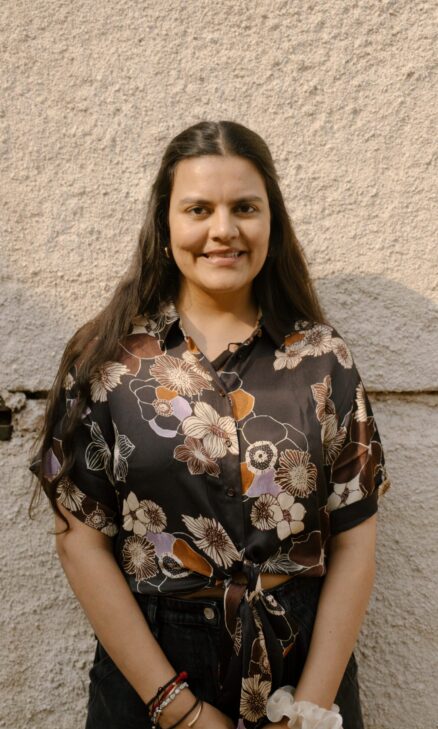
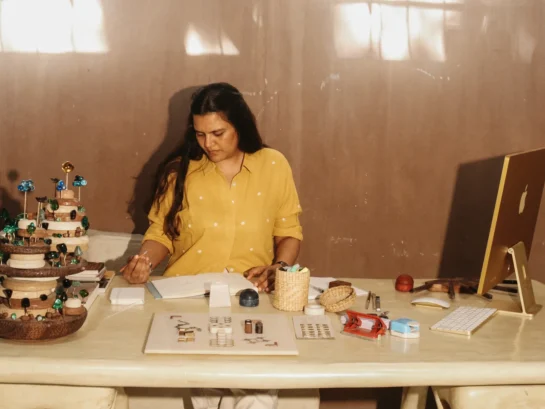
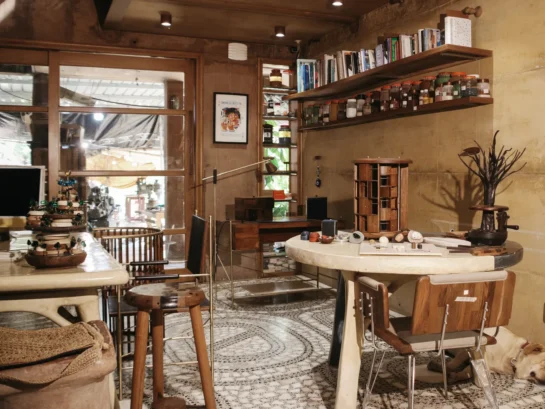
Priyanka Shah speaks to Blur The Border :
Blur : You trained as an architect, but you’ve often spoken about how your real education came from working directly with materials and the artisans who shape them. What drew you away from blueprints and into the more tactile world of making?
Priyanka : I am enamoured by the world of architecture and how architects think: it baffles me the amount of commitment there is to a single idea for such a long amount of time, all while being subject to so many tangible and intangible forces of nature in that duration. I wanted to narrow my focus onto the making and the physical, tangible touchpoints: connections to the people who are actually on site, making things happen. I love the frenzy of communicating on site and then seeing immediate results of that in what is being made. I love to shorten the distance between thinking and making, and I have tried to keep flipping the two in different measures throughout my practice.
Blur : Pieces like Ring-a-Vase and Wooing the Table take familiar, everyday objects and reinterpret them in completely unexpected forms. How does an idea like that begin for you, and what does it take to translate an intricate or unconventional detail into something that works beautifully in the final piece?
Priyanka : For me, there is no such thing as an objectively perfect chair or table (or any other such objects). As kids, we were taught this generic landscape drawing with three triangles for mountains, one square house with a triangle on top and other more generic visuals that were the ‘correct’ way to draw back then. The day I actually visited a mountain as a child, I remember thinking to myself this is nothing like what we drew in class. From this point on, I decided to never take for granted these generic images for things around us. For me, each detail is one more observation from the real world or an imagination of how something could be.
Blur : Do you have any particular processes, habits, or rituals that help you enter a creative mindset before beginning a new piece?
Priyanka : Lots of conversations with different people from my team… it is these conversations that spark my thoughts and imagination more than anything. Lately, I have also been going to the forest near me in Amsterdam: cycling, picnic basket, just basking in the greens and good weather. It has been doing wonders for me in terms of clarity and focus.
Blur : Is there a piece or project that took significantly longer than expected to get right? What did that process teach you about patience, craftsmanship, or your own definition of value?
Priyanka : Almost every project for us takes longer than expected because we like to push boundaries. We are grateful to our collaborators/clients because of the grace and patience, and that’s the only reason why we are able to push on this!
Our carousels are perhaps a shining example here – we created the Bombay Carousel over 9 months of production after about 3 months of ideation! This included trips to Bombay for on-ground studies and research. Every single piece that has gone into the project was photographed, sketched, ideated, drawn and then transferred on materials iteratively: imagine this being done to approximately 40-45 unique elements and then all the handmade processes to bring the ideas to fruition, and then finally converting this into a piece that rotates in two different directions… no matter what the timelines at the outset, we will invariably go deeper into the project as we go along. The truth is that these pieces require this type of treatment for them to generate the type of experience and joy around them that they do!
Blur : You’ve described your relationship with artisans as collaborative, while still working within a clear design framework. What does that collaboration look like in practice, and how do you balance creative freedom with structure?
Priyanka : I love dialogue. I really enjoy it when I am challenged, and when I have to work even harder on convincing my team about my ideas. Our environment is one where everyone must express their opinions and it is those that shape our projects eventually. This is what ensures the best outcome for each project. The inherent constraints that come from what we can do inhouse at our workshop, what tools we have access to, and also how far we are able to push our skills within the bounds of a particular project and its timelines, govern the structure of things finally.
Blur : If you could collaborate with an artist or maker completely outside your own discipline, who would it be, and what would you want to create together?
Priyanka : Three answers: 1) a sitar player to create a ‘baithak’ atmosphere and generating places/environments for different ragas 2) an ‘everything-ist’ like Es Devlin or William Kentridge 3) puppetry artists and creating imaginary worlds for them to inhabit
Blur : SHED made its international debut at the London Design Fair in 2016. Since then, how has your perspective on Indian design—and its place within the global design conversation—evolved?
Priyanka : I have always felt like Indian design has been very under-represented on the world platform; the reason is that there has been no language to be able to ‘describe’ our ways. When I studied in New York too, I had a deep sense that India was fully missing from global design discourse. The Western view towards design is so intrinsically linked to the Industrial Revolution, faster production cycles, optimized assembly lines and automated production; the Indian lens has been predominantly craftsmanship and craftsmen-oriented, embracing human intelligence, embracing variety and resourcefulness (jugaad), traditional methods that have been carried through time and lineages of people and clusters. I have always been interested in the conversation between the two. I do not believe they are different; they just operate out of a different set of conditions. I have no doubt in my mind of the legitimacy of Indian design/art/craft discourse on a world platform: the onus will be on us to stay confidently true to who we are and own our voice.
Blur : You’ve said that one of the greatest luxuries is the time embodied in a piece. In an industry increasingly driven by speed and scale, how do you protect slowness as a value rather than allow it to be perceived as a limitation?
Priyanka : I believe people are starting to see how disruptive speed and scale has been for the world. People are starting to wake up to the atrocities committed by us on nature, and there will be no choice but to slow down. The value of this slowness is automatically on the rise without me trying!
Blur : Running a design studio inevitably involves balancing creative instinct with entrepreneurship. How have you navigated the relationship between the two, and has that balance changed over the years?
Priyanka : I think entrepreneurship is deeply creative! I love the idea of organizing people and a workforce in order to solve different things, especially the question about ‘scale’. The studio is not limited by my physical involvement and that to me is a very freeing notion. I like having the freedom of being able to do more than the individual capacity of a person, and that really is embedded into the studio and its working style more and more. In order for it to function like a collective, the only way to ensure that long-term is to enable business opportunities wherever and whenever possible. Creative and entrepreneurial instincts are not to be seen at odds with each other.
Blur : What is a question you find yourself sitting with at the moment—something you don’t necessarily have an answer to yet, creatively or otherwise?
Priyanka : I have been thinking about why certain places make us behave differently. You enter a library and automatically whisper. My kitchen spaces (current and past) always inspire this sense of frenzy and quickness. You go to someone’s home and somehow start following their little rituals without thinking about it.
I find it fascinating that a space can influence us without actually telling us what to do. I’m curious about how much of that can be designed and how much just happens over time.
Blur : What’s next for SHED that you’re particularly excited about—a new material, collaboration, experiment, or direction that people haven’t seen from you yet?
Priyanka : We have finally started dabbling in smaller products and are launching an e-commerce platform! I am keen on developing a body of work entailing small objects, more daily-life functional objects but carrying the same craft ethos in them. I really do want to test and experience how craft can enter our modern lives with more intention.
Know more about Priyanka:
Website: https://www.outoftheshed.com/