Ōkami Life
An Indian fragrance house built on restraint, treating scent as structure rather than spectacle.
Fragrance in India still mostly sells volume, loud sillage marketed as value, longevity as the only metric worth advertising. Ōkami was built against that instinct, borrowing its restraint from an unlikely place: the founder's early fascination with Issey Miyake, and the idea that structure could matter as much in a scent as it does in a garment.
That restraint shows up as a kind of quiet confidence. Ōkami's founder has described the brand as anti-attention economy, more interested in how little can be said and still make someone feel something, than in announcing itself the moment someone walks into a room. It's a fragrance house that treats scent as a final touch rather than an opening statement, closer to something a wearer discovers on themselves than something a room is asked to notice.
That same discipline shapes how a new fragrance actually gets made. Rather than starting with notes, Ōkami starts with a world. Its first series, Elementals, drew from wind, ocean, night and sun; its second, Origins, opened with Sora and Dojo, sky and earth. An upcoming chapter takes its visual language from Japanese postage stamps from the post-war period, a moment of national reinvention, translated here into scent, bottle and carton as a single, unified idea rather than separate decisions.
The growth has followed the same unhurried logic. Two viral tweets from within India's finance and investment community, and little else, carried Ōkami well past what it had planned for, without a single rupee spent on performance marketing. An 11-month-old brand holding a 17 percent return rate suggests something sturdier than a moment: a fragrance house building, deliberately, for a consumer who already knows what restraint is worth.
Ōkami speaks to Blur The Border :
Blur: What gap did you feel existed in the Indian fragrance space when you first started Ōkami?
Ōkami: I think what I felt was missing was originality. There were a lot of new-age perfume brands coming up in India, but I wasn’t seeing enough novelty in the fragrances themselves. And then, of course, India has incredible perfume houses doing attars and traditional perfumery very well, but that was never really my taste.
I’ve always been more drawn to fragrances like Issey Miyake, where there’s a certain architecture to the scent. You can experience the top note, the heart, the base; there’s structure, there’s restraint, and the fragrance evolves rather than everything hitting you at once.
So I think Ōkami came from that very personal gap. I wanted fragrances that felt original, modern and structured, but still had a distinct point of view. I couldn’t really find that in the Indian market in the way I wanted it, so eventually the thought became: why not build it ourselves?
Blur: What do you think sets Ōkami apart from the growing number of fragrance brands emerging in India today?
Ōkami: I think what sets Ōkami apart is that, frankly, I don’t spend too much time looking at what other brands are doing. I have a bit of tunnel vision when it comes to building the brand. I’m focused on our pipeline, our portfolio, and the kind of perfumery we want to create.
A lot of that comes from the Japanese philosophy behind Ōkami. In Japanese culture, wearing an extremely loud fragrance can be considered intrusive because your fragrance shouldn’t disrupt the environment around you. Someone standing next to you should be able to smell you; the entire room doesn’t need to.
Of course, if you’ve sprayed a perfume twenty minutes ago and step into a lift, people will smell it. But it shouldn’t linger in a room long after you’ve left. I’ve seen fragrances designed almost to overwhelm the ambient environment around the wearer, and that’s simply not what we’re trying to do.
What we hear consistently from our customers is the subtlety and durability of our fragrances. They’re minimal and personal, but they last. For us, perfume is the final touch rather than the first thing that announces your presence.
And that’s also why we naturally speak to more seasoned perfume users—people whose first question isn’t just, “How long does it last?” but “When does the passion fruit come through?” or “How long does the musk hold in the composition?” That curiosity about the architecture of a fragrance is very much what Ōkami is about.
Blur: Consumers today are paying closer attention to ingredients, craftsmanship and storytelling. Which of these has resonated most with your community, and has anything surprised you?
Ōkami: I think both matter, but in very different ways.
On ingredients, for us, that’s almost basic hygiene. We worked with a perfumer to develop our fragrances, we use high-quality fragrance oils, and our formulations are free from phthalates, endocrine disruptors and microplastics. We’re quite transparent about that as well—if somebody wants to see a certificate of analysis, we’re happy to share it. But I don’t think clean formulation should necessarily be the story. It should be the starting point.
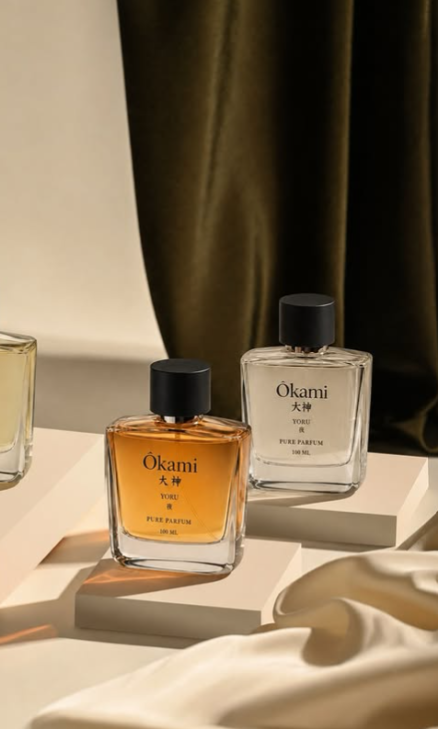
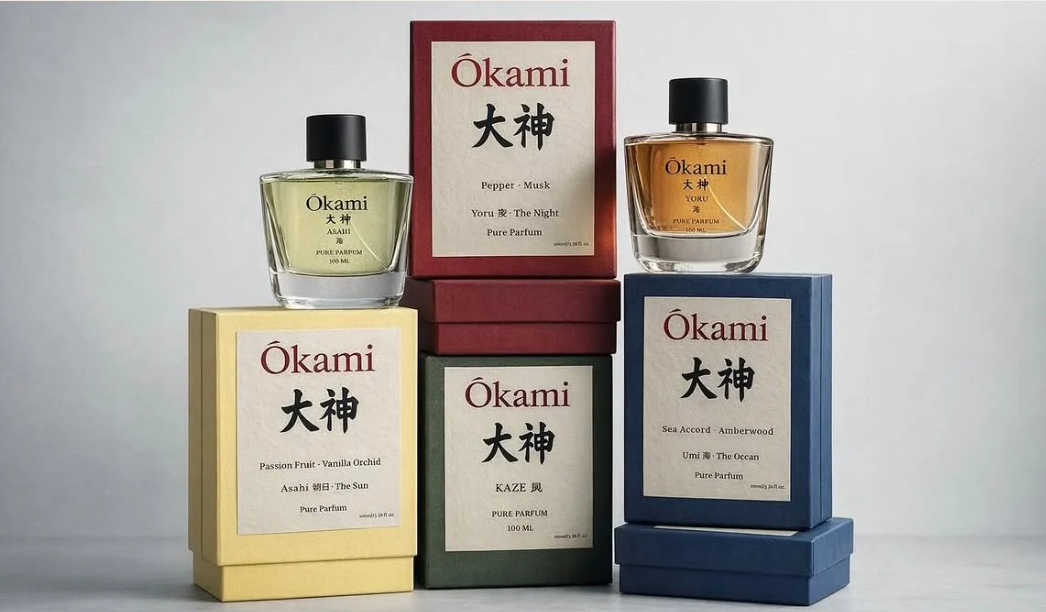
What I find much more compelling is how much you can communicate by doing very little. Our storytelling uses very few words. Our boxes aren’t covered in illustrations or information. The bottles are essentially glass, black and the colour of the fragrance. And yet, it creates an impact.
I think that restraint has resonated with people. We allow every component to do its own talking—the fragrance, the bottle, the name, the story—without everything competing for attention.
In a way, Ōkami is anti-attention economy. We’re not trying to constantly shout louder to be noticed. We’re interested in seeing how little we can say and still make you feel something.
Blur: In a category like fragrance, where people can't experience the product online, how important has word of mouth been in helping Ōkami grow?
Ōkami: Word of mouth has actually been fundamental to Ōkami’s growth, and interestingly, that wasn’t the original plan.
Ōkami was supposed to be primarily a retail project, with kiosks across a few malls in the country. Then, through a WhatsApp group, a prominent voice on Instagram and in the investment community discovered us and tweeted about the brand. That tweet went completely viral. Around 2,500 people bookmarked us, and we were completely unprepared for the kind of attention it brought.
That led to another prominent voice in the finance community discovering us and tweeting about Ōkami on 2nd October, which became our second moment of virality.
So from our launch in August until mid-December, without spending anything on Facebook or performance marketing, we did over ₹20 lakh in sales. It was almost entirely discovery, conversation and people recommending the brand to other people.
And I think the strongest validation of that is what happened afterwards. We have a customer return rate of over 17%, which, for an 11-month-old brand with only four fragrances, is a very meaningful number for us.
So yes, especially for something you cannot smell through a screen, someone else saying, “You need to try this,” has probably been one of our most powerful forms of marketing.
Blur: Having built a brand in India, what's one change you'd like to see in the consumer brand ecosystem?
Ōkami: I’m a big advocate for what I call the taste economy. I think the next phase of consumer brands in India will be about products built not just around a market opportunity, but around taste. We’re already seeing this in apparel, where there are some incredibly artful, thoughtful brands being built. But across many other categories, that kind of boutique, taste-led approach is either dominated by a few players or largely absent. I think the time has come for boutique products built with a very specific point of view. You don’t necessarily need to design for everyone. You can design something around your own taste, find the people who share it, and build something meaningful around that.
And for me, Ōkami is evidence that this can work. There is a consumer in India for products with taste, restraint and a distinct point of view. You can build for that consumer—and it will work.
Blur: Walk us through how a new Ōkami scent comes to life — where does the idea usually start, and how long does it take to go from concept to bottle?
Ōkami: I think the idea of perfume as bottled art is very real for us. And if you think about how an artist works, they rarely think of one piece in isolation. They think in terms of a series, and then individual works emerge from that larger idea. We approach fragrance in much the same way. Our first series, Elementals, was built around four elements—the wind, the ocean, the night and the sun. Each fragrance takes one of those elements and interprets it through scent.
Our second series is called Origins, and it begins with two fragrances: Sora, the Sky, and Dojo, the Earth. We also have something else in development that I think will be quite new for the perfume space.
Once we have the larger concept, we start asking what that particular fragrance should feel like. Who wears it? When do they wear it? What mood or occasion does it belong to? That becomes the brief we take to the perfumer, and from there we start developing the juice.
But the fragrance isn’t developed separately from the rest of the product. The scent, bottle, carton and visual language are all artistic impressions of the same idea, so they evolve simultaneously.
For our next chapter, for instance, we’re taking visual inspiration from Japanese postage stamps from the post-war period, a time when Japanese society was reimagining and rebuilding itself. So the process really begins with an idea, and everything—from the juice to the carton—is an interpretation of that idea.
We don’t start with notes. We start with a world, and then build the fragrance that belongs in it.
Blur: How do you think about balancing Indian sensibilities with global fragrance trends when developing new fragrances?
Ōkami: I think our primary audience is the global Indian. And I relate to that consumer personally. I’ve been educated abroad, I’ve lived across cultures, and I tend to think of the world as a global village.
That Indian consumer today is incredibly internet-savvy and culturally aware. They understand nuance. They understand that different regions, cultures and traditions have their own sensibilities, and they don’t need those ideas to be simplified for them.
So when we take inspiration from Japan, for instance, it isn’t just about Japanese minimalism. It also informs how we build the company—the commitment to precision, where every batch should be like the batch before it; the commitment to honesty in what we make and communicate; and ultimately, our ambition to become India’s most trustworthy fragrance house.
So I don’t necessarily think of it as balancing Indian sensibilities against global trends. We are an Indian fragrance house built for an Indian who is already global in the way they think, consume and experience culture.
Know more about Okami:
Website: https://okami.life/
Instagram: @okami.parfums