Rajka Pottery
Rooted in an ancient South Indian coiling tradition, Rajka Pottery brings a technique thousands of years old into a contemporary studio practice, where every form continues to be shaped entirely by hand.
Break a piece of pottery and it barely disappears at all. A single shard can survive long enough for archaeologists to reconstruct centuries of technological and social change from it alone. India's ceramic tradition stretches back to the Neolithic period, roughly seven thousand years before the present, long before the potter's wheel existed, when large vessels were built patiently by coiling ropes of clay entirely by hand. That older, wheel less technique never fully disappeared. It survived in pockets of Tamil Nadu, among artisans who continued making monumental Ayyanar deities, horses, elephants and guardian figures, using coiling alone. That surviving technique is where Rajka Pottery begins.
The brand's own beginning is worth telling as a story in its own right. In the early 1980s, textile designer Rajshree Sarabhai, co-founder of Rajka Designs, met V Sambandham, a master artisan from Tamil Nadu who had travelled to Ahmedabad carrying a terracotta Ayyanar deity. Sambandham ad never made a pot before; his skill lay in sculpting the monumental figures long central to the Ayyanar tradition, not vessels. Rajshree, who had recently seen an exhibition of Chinese pottery and was developing her own growing interest in ceramics, recognised something in his coiling technique that he hadn't been looking for, a way to build pots, not just deities. She invited him to set up a small studio at her family home in Ahmedabad, and together they began experimenting, turning an ancient sculptural practice into functional pottery for what was likely the first time. Their first collection, hand built pots ranging from one to five feet tall, drew inspiration from traditional Indian metal vessels, particularly those long associated with Gujarat, and became Rajka Pottery's founding body of work.
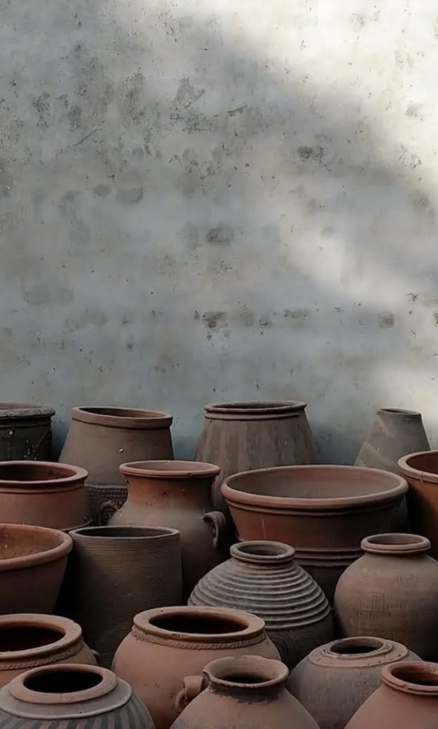
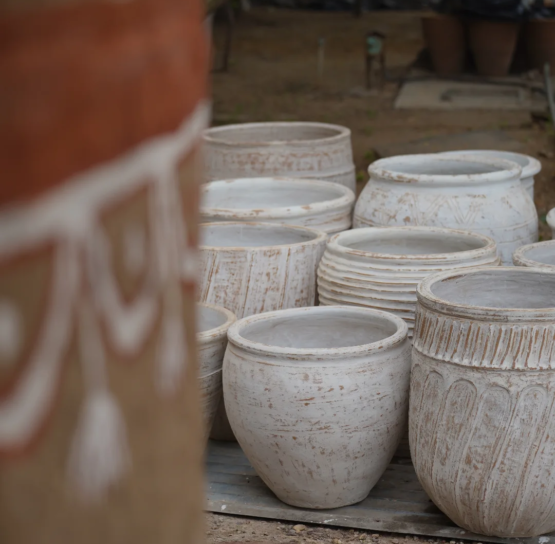
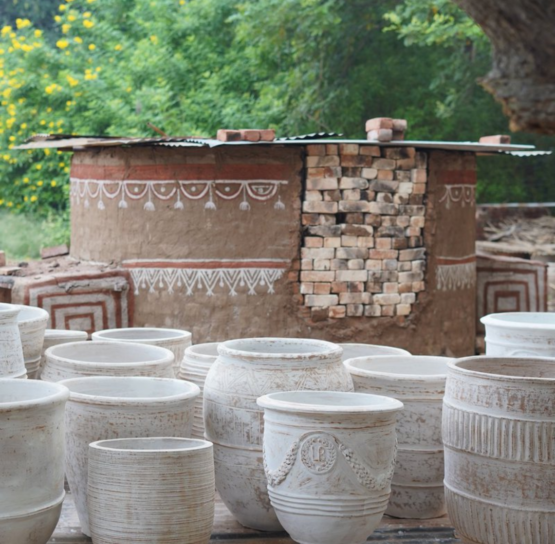
More than four decades later, under the stewardship of Samvit Sarabhai, Rajshree and Kartikeya's son and the studio's current director, that same coiling technique still defines the studio at its core, the terracotta dabbar and wooden paddle still doing the work a wheel never did here. Current collections now draw inspiration from the painted pottery and Zebu bull figurines of the Indus Valley Civilisation, alongside archaeological ceramics from other parts of India and the world, bringing forms thousands of years old into a working, contemporary studio practice rather than a museum case. The designs range widely enough to sit as easily in a traditionalist's home as a distinctly modern one, each styled in its own way. Most pieces carry a natural, unglazed finish that leaves the coiling and the hand work underneath visible rather than polished away, and scale varies just as widely, from small tabletop pieces to the room filling pots and figurines the studio first built its name on.
What makes Rajka remarkable, according to those who have studied it closely, isn't simply that the work is handmade, it's how it is made. Coils of clay are stacked one on top of the other and shaped entirely by hand, then refined with a dabber or paddle, the same basic tools potters were using thousands of years ago. It is a living demonstration that craft traditions survive not by staying frozen in time, but by being remoulded, generation after generation, much like the clay itself, each new hand finding a new way to hold what came before it.