
Sanket Viramgami
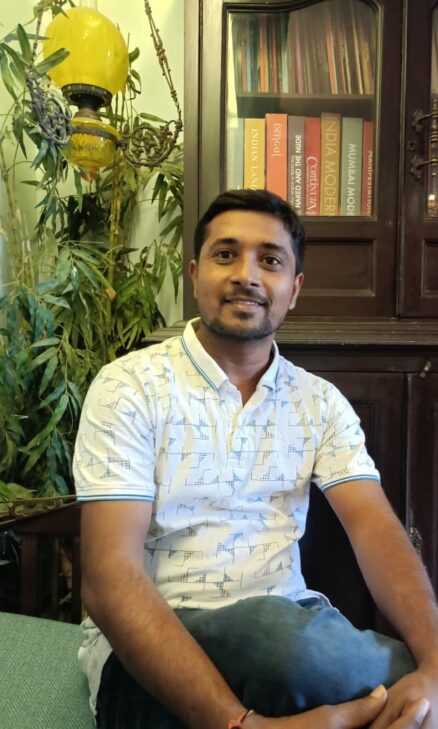
Recipient of the Elizabeth Greenshields Foundation Award (2017), the Sanskriti Kala Puraskar National Award (2017), and the Jeram Patel Award (2011), Sanket Viramgami is a Gujarat-born artist (b. 1988), currently based in Baroda, whose paintings unfold as dense, immersive worlds—at once intimate and expansive. Stepping in front of a Sanket Viramgami painting feels like entering a carefully stitched landscape populated by figures who appear mid-thought, mid-gesture, mid-journey.
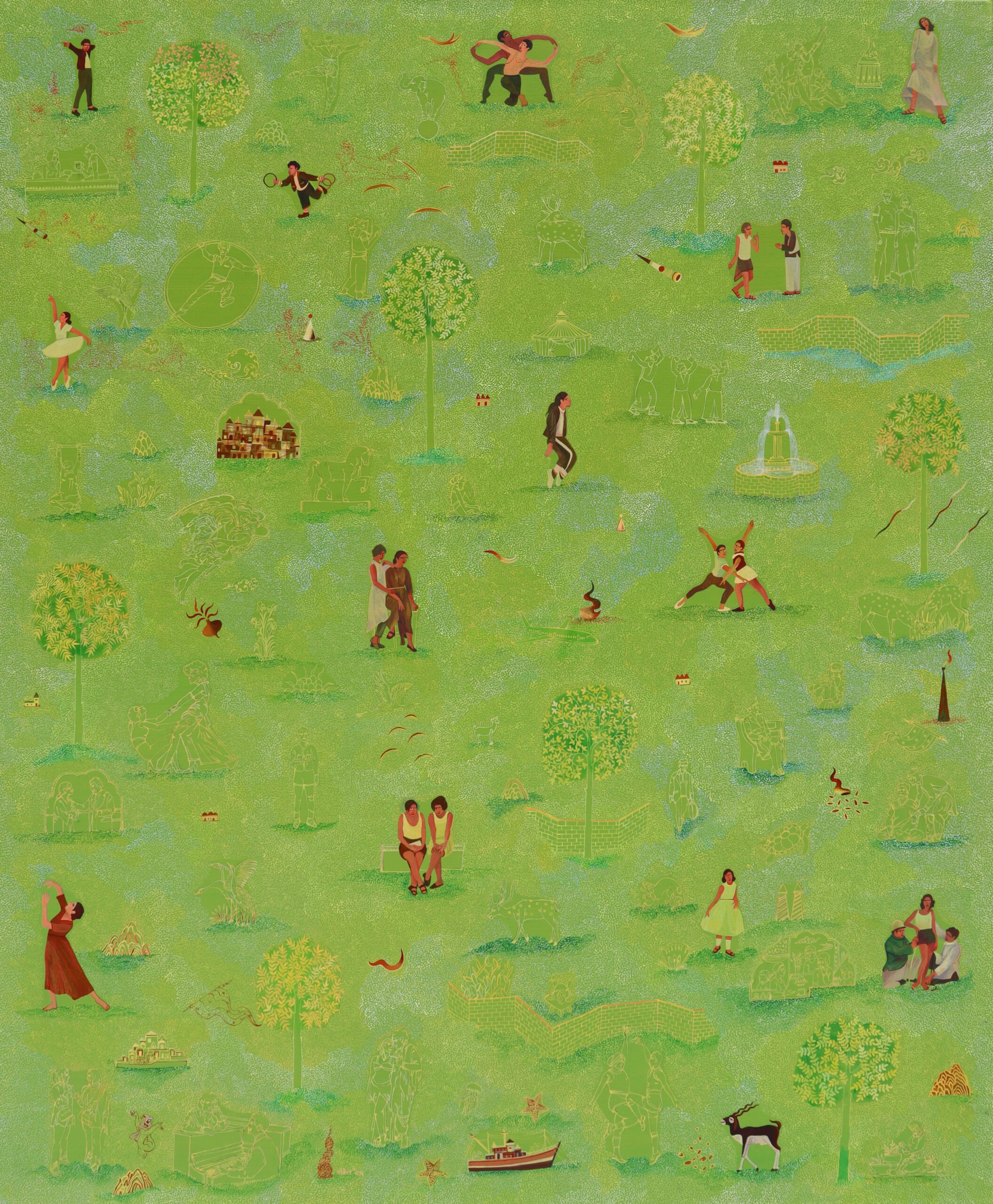
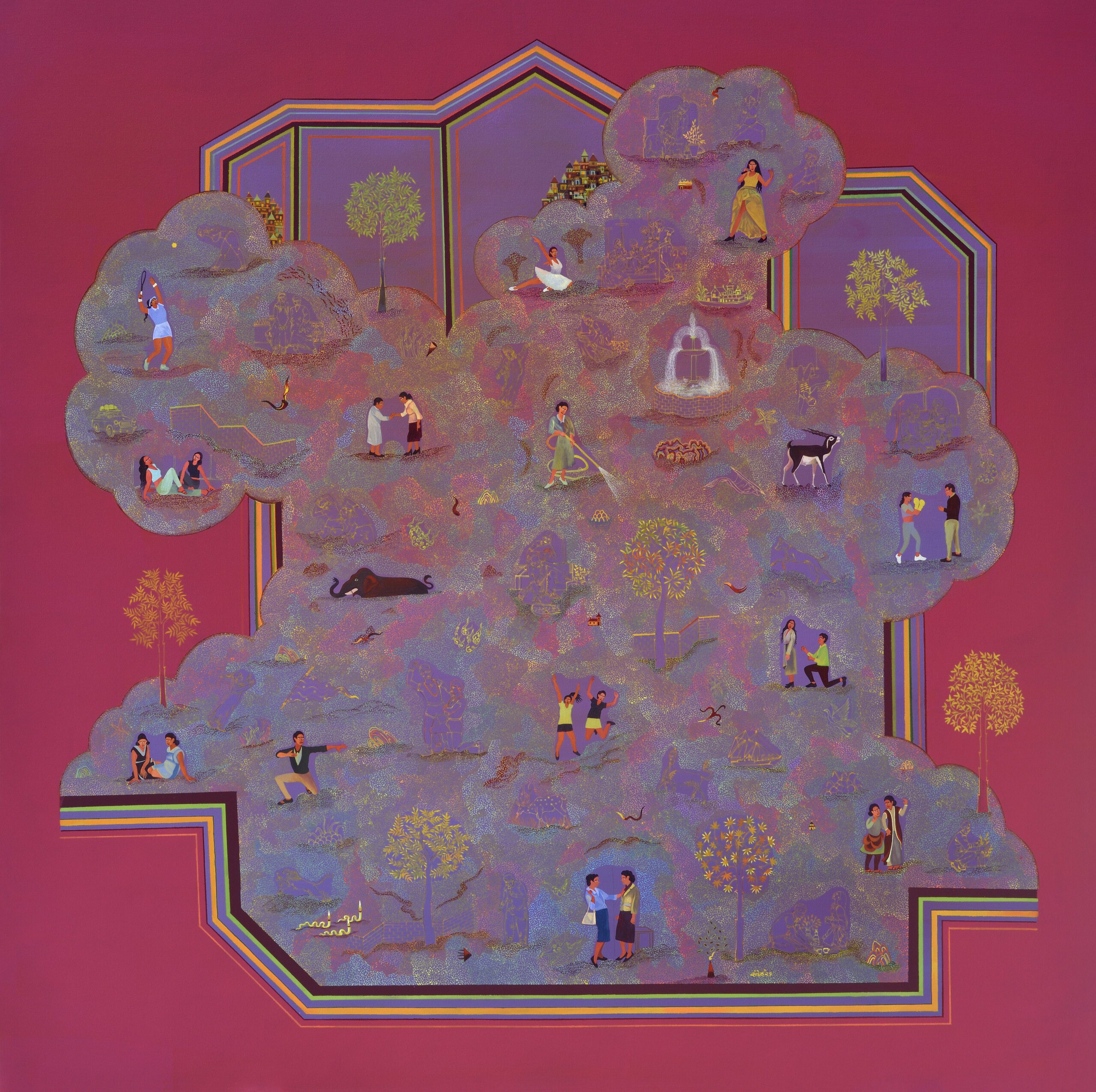
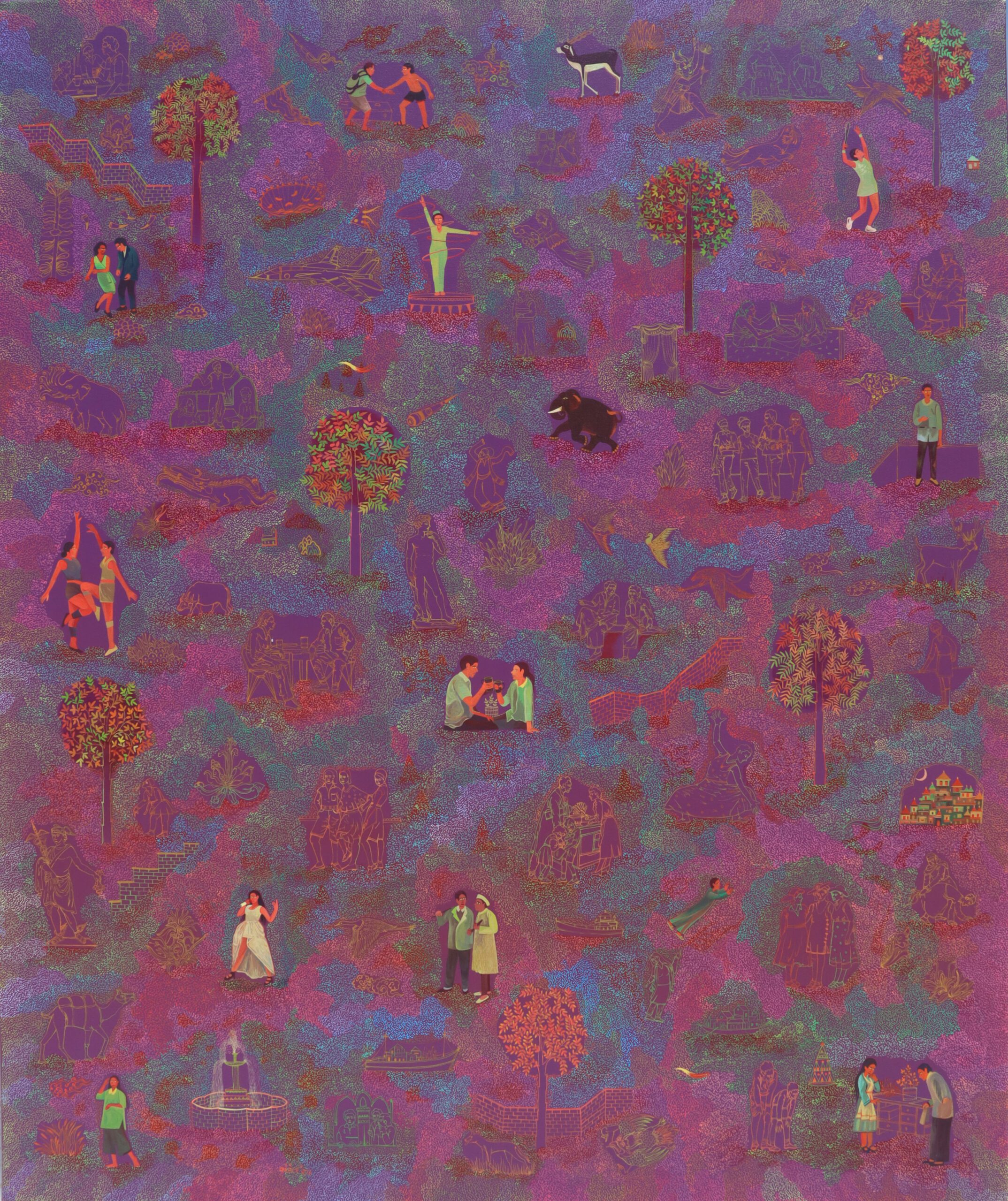
Human and animal forms move through richly detailed terrains enveloped in foliage walking, resting, conversing, simply existing. These scenes do not announce a single narrative. Instead, they hold multiple moments at once, allowing time to bend and overlap within a single pictorial plane. One of the most recognisable features of Viramgami’s work is this interplay between landscape and figuration. His canvases often read as panoramic spaces where scale shifts subtly and perspectives collapse. Seventeenth-century courtly figures might share space with contemporary presences, not as historical quotation but as lived coexistence. The result is a visual language that mirrors memory itself nonlinear, layered, and crowded where past and present are held together without hierarchy. What makes Viramgami’s practice particularly compelling is the way density becomes a form of invitation. His paintings do not reveal themselves all at once. Meaning accumulates slowly, through repeated looking, as motifs recur and migrate across the surface. Pattern, ornament, and imagery are built through meticulous layering, creating compositions that are both intricate and immersive. His visual vocabulary draws from a wide range of sources without settling into pastiche. References to Persian miniature painting sit alongside Indian craft traditions such as Kantha, while elements reminiscent of Gond visual language appear woven into the pictorial field. These influences are absorbed rather than quoted, forming a surface that feels richly textured and rhythmically alive. His colour palette shifts between earthy, grounded tones and heightened, almost theatrical hues, lending the works a mood that oscillates between romance and unease. Underlying this visual abundance is a worldview shaped by Viramgami’s own movement between rural and urban contexts. Themes of mythology, folklore, personal memory, and quiet political undertones recur throughout his work, not as declarations but as atmospheres. Landscapes appear familiar yet slightly estranged, reflecting changing environments and evolving ways of living. The figures within them seem suspended aware of history, yet firmly situated in the present. Viramgami earned his Bachelor of Visual Arts (2011) and Master of Visual Arts (2013) in Painting from the Faculty of Fine Arts, Maharaja Sayajirao University, Baroda. This academic grounding is evident in his assured handling of composition and surface, as well as in the disciplined way his paintings balance excess with control. Over the years, his work has been shown across significant national and international platforms, including India Art Fair (2026), Art Dubai (2025), and Delhi Contemporary Art Week (2025), all with LATITUDE 28, New Delhi, marking the steady evolution of his practice within the contemporary art circuit. Within the landscape of contemporary Indian painting, Sanket Viramgami occupies a space where tradition is neither preserved nor discarded, but treated as raw material something to be reworked, layered, and reimagined. His paintings hold together multiple temporalities, visual languages, and emotional registers, offering a quietly complex reflection of an India negotiating its histories within the pressures of the present. In doing so, his work speaks not only to personal memory, but to a broader cultural condition one where continuity and change are inseparable.
Sanket Viramgami
Untilled, 2025
Acrylic on Canvas
58 x 48 inches
Sanket Viramgami
Diversity, 2026
Acrylic on Canvas
60X 60 Inches
Sanket Viramgami
Untilled, 2025
Acrylic on Canvas
58 x 48 inches
Sanket speaks to Blur The Border :
Blur : Can you take us back to your early relationship with painting— what were the first images, lived experiences, materials, or visual worlds that compelled you to make art?
Sanket : Before coming to Baroda, I was deeply drawn to image-making—such as creating Ganesh figures in wedding houses, copying photographs, and doing wall paintings. After arriving in Baroda, I began practicing object drawing, still life, and sketching and texture. During this phase, I started getting attracted to the small, everyday activities of daily life and the stories hidden within them. Gradually, I began narrating these moments through image-making, and over time this approach evolved into my own distinct visual style.
Blur : You trained at MS University, Baroda, a space known for shaping strong artistic vocabularies. How did your time there influence the way you think about history, material, and narrative in painting?
Sanket : I was influenced by many things here, as the Baroda art school is known for its strong narrative tradition. It was here that I began to understand art history—both Indian and Western. I went on several art tours, such as to Ajanta and Ellora, where I closely observed the way stories are narrated through images, especially in the murals of Ajanta, which left a deep impact on me. During this time, I also learned to work with natural colour pigments and gained an understanding of how materials function within art. I was introduced to image-making through texture, form, and shape, and how these elements contribute to visual storytelling. All these experiences became an integral part of my practice, and I found myself deeply influenced by Indian miniature and Mughal miniature painting traditions.During the Fine Arts Fair at the Baroda school, various workshops are organized, such as vegetable dye painting, glass painting, mural work, and fresco. Engaging with these diverse mediums had a strong influence on me, as each process opened up new ways of thinking about material, surface, and image-making, further enriching my artistic practice.
Blur : Do you have a definitive process while creating? Are there any habits or rituals that help you get into a creative mindset?
Sanket : Yes, I do follow a definitive process, but it also depends on the nature of the imagemaking and the story I want to convey—whether a particular image needs to be developed into a painting or retained as a line drawing. My daily practice always begins with sketching, observing the activities around me. At times, I also take photographic references and study miniature painting books, using them as visual and conceptual references within my practice.
Blur : What role does the environment play in your work or in fueling your creativity?
Sanket : Baroda is filled with artistic activities such as exhibitions, art talks, workshops, and theatre. Being present in these spaces, meeting people, and learning new perspectives—about art, the art market, and artistic practice—has been an important part of my journey. I often engage in discussions around materials and image-making, which further shape my understanding. Through these experiences, I get to see the work of new artists, interact with senior practitioners, and take part in studio visits. In these ways, I remain constantly energized,staying connected to the pulse of the art world and deeply enjoying the creative atmosphere around me.
Blur : Your work is recognisable for drawing on miniaturist traditions and traces of Indian craft, often featuring landscapes with figurines. What draws you to depicting multiple narratives within one single frame? In your view, does this add to the recount ability of your work, or can it sometimes also feel limiting as an artist?
Sanket : My work is narrative-based, which is why a single work often holds many stories. These small narratives come together to form a larger story, interacting with one another and allowing the images to play off each other, helping the imagery feel alive and in motion. This process never feels limited or complete; instead, it constantly urges me toward another painting. Because the stories are many and deeply interconnected, one painting naturally flows into the next, creating a continuous shift and extension of the narrative across works.
Blur : You have shown extensively across India and internationally, from the Kochi Biennale to Art Dubai. Have you observed your work being read differently in different cultural contexts? Has viewer interpretation ever surprised you in ways that reshaped how you see your own work?
Sanket : Yes, outside my immediate context, my work has been viewed from many different perspectives, as cultures and ways of thinking vary widely. Often, viewers relate my work to their own stories, connecting with it on a personal level and expressing their joy through these associations. Since my work draws from everyday life and moments of positivity, I use a universal visual language that allows these connections to emerge naturally. There have been many instances where viewers, while relating the images to their own experiences, share new narratives and actively “read” the images. At times, their excitement and the stories they bring become absorbed into my practice, finding their way into the development of new works.
Blur : What role have galleries and institutions played in shaping—not just promoting—your practice?
Sanket : My education at college taught me how to visualise—understanding methods, exploring different techniques, and engaging in continuous artistic practice. I learned how images are created and how to question an image: what kind of relationship one forms with it, and how meaning unfolds through that engagement. Regular exhibitions and displays became an important part of this learning, as they allowed interaction withdiverse audiences and an understanding of how viewers perceive and interpret the work. Institutions play a crucial role in shaping an artist, and galleries have an equally significant role, as they provide the space, design the presentation of the work, invite viewers, and create platforms for gathering, dialogue, and exchange.
Blur : Are there materials, scales, or formats you are currently curious to explore beyond painting?
Sanket : Alongside painting, I am deeply interested in learning and practicing fresco, particularly Italian fresco, which strongly appeals to me. I wish to explore this medium for its historical depth, material process, and its close relationship with architecture and time. I am especially drawn to working with vegetable dyes and natural pigments, and I plan to experiment with them across different sizes and scales. Through this exploration, I aim to understand how material, surface, and technique influence image-making, and how these traditional processes can be reinterpreted within a contemporary artistic context.
Blur : If you were to collaborate with another artist, within or outside your discipline, what is one collaboration you would love to explore?
Sanket : If I were to collaborate in the future, I would be interested in creating rugs through the lens of image-making. I see rugs not merely as functional objects, but as surfaces fornarrative and visual exploration. Through collaboration, I would like to translate paintedor drawn imagery into textile form, engaging with scale, texture, pattern, and materiality. This process would allow images to move from the wall to the floor, transforming into tactile, spatial experiences. Such collaborations would open new dialogues between art, craft, and design, and expand the ways in which images are produced, perceived, and lived with.
Blur : With the artistic landscape evolving so quickly, what is one question you’re sitting with—or one you think our community needs to reflect on and discuss more openly right now?
Sanket : In the contemporary moment, it is important for an artist to move in rhythm with thetimes—remaining open to new mediums, materials, and design languages. Exploring and understanding these evolving forms is essential, but this exploration must be grounded in a deep awareness of one’s roots. By first understanding cultural, historical, and personal foundations, an artist can meaningfully engage with contemporary practices without losing authenticity. It is this balance between tradition and experimentation that allows artistic practice to remain both relevant and rooted, enabling new expressions to emerge while carrying forward inherited knowledge.
Know more about Sanket:
Instagram: @sanketviramgami