
Vihar Kotecha
Blending Indian temple architecture, Scandinavian restraint and modern digital craft, Vihar Kotecha creates sculptural worlds that span the handmade and the high-tech. His evolving practice across porcelain, furniture, illustration and digital sculpture reflects a belief that creativity lives in the idea, with each medium becoming a different way to express it.
Born in Ahmedabad and raised in Vadodara, contemporary artist and designer Vihar Kotecha brings together the disparate worlds of handcrafted forms and 3D technology in his sculptures. Notably laced with detail and seemingly a leaf out of history, these monoliths mirror highly decorated pillars–a revered architectural form in ancient India. The prelude to these sculptures lies in Vihar’s long-held fascination with the temples of Gujarat and Rajasthan. It later evolved into its signature form, shaped by the simplicity of Scandinavian design during his master’s in Contemporary Design at Aalto University in Helsinki. Titled Resurgence and showcased at the 2025 edition of India Art Fair, Vihar drew attention for these porcelain sculptures crafted using a 140-part slip-casting mould based on radial symmetry. What stands out most, however, is how he hasn’t replaced traditional skills with technology, but instead uses modern tools to make the time-honoured processes of moulding and carving more precise. Indian heritage seems to be a continual, powerful influence on Vihar's design vocabulary. His earlier works reveal an equally strong connection to the country’s urban landscape that immortalise advertisements on concrete barriers—imagined as 3D digital sculptures. The command over Vihar’s creative oeuvre, broad and equally palpable, stems from a confluence—of cultures, disciplines, and media. In stark contrast to his highly detailed sculptures, this directory of work also includes furniture design that embodies a sleek and minimalist language, digital sculptures that peek into utopia, and illustrations, a few of which re-imagine the future remains of cultural heritage. With a range of distinguishable calibres emerging from several artists today, Vihar stands out boldly as someone who doesn't creatively constrain himself to a single mode. Rather, he sees each medium as a different outlet for his expressions, strongly asserting that true creativity ultimately remains in an artist’s concept, and it is how they choose to wield the tools that makes the difference. Whether it's the ‘Siren Stool’, whose circular frame in vivid red despite embracing a minimal spirit is far from an ordinary seat, or his digital sculptures from the 'Immortalised' series that resemble monuments that exist in real-time. This duality clutches the root of Vihar’s artistic prowess—seen in the remarkable ability to move between ‘extremes’: the past and the present, the minimal and the elaborate, and the digital and the physical. Embracing versatility, artists like Vihar are pushing beyond the long-standing notion of mastering a singular skill, embracing versatility more than ever and even the challenges that come with it. The amplitude in their artistic voice has come to encapsulate a wide range of talents, moving fluidly from the clarity of minimal works to the complexity of elaborate details.
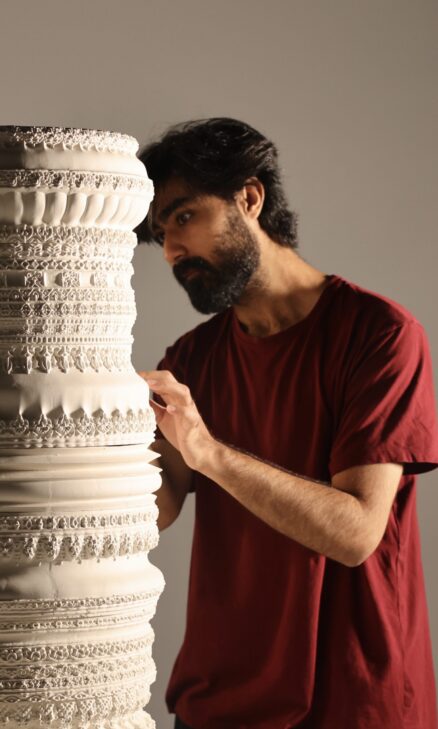
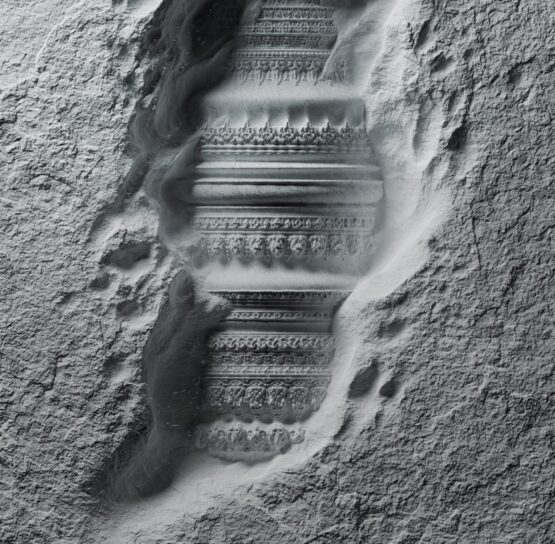

Vihar speaks to Blur The Border :
Blur : Your practice is notably broad, spanning two different cultures, mediums (porcelain, wood, glass), and disciplines (furniture, digital art). As an artist with such a dynamic range, what draws you to move between these different forms, and what is a common thread that ties all your work together?
Vihar : My practice moves fluidly between materials and mediums because it's a way for me to tell stories through different languages. Whether working with physical materials or digital tools, I’m drawn to how ideas shift character when translated through different processes. For me, each material and medium carries its own rhythm and history, and engaging with them allows me to tell stories that feel both personal and universal.
The dialogue between Indian and Scandinavian sensibilities forms the foundation of my sensibility. I aim to merge these worlds to find balance between expression and silence, tradition and clarity. What connects all my work is the pursuit of meaning beyond function: creating objects that are experiential, evocative, and part of a larger ecosystem of ideas. Each piece becomes a small reflection of how I wish the world to feel—rooted in craft, yet open to imagination.
Blur : How does the environment impact your work and fuel your creativity?
Vihar : The environment deeply shapes my way of thinking and making. Growing up in India surrounded by ornament, craft, and warmth gave me a sensitivity to detail and narrative, while living in Scandinavia introduced me to clarity, restraint, and silent grace. These two worlds continuously inform my work, one fuels expression, the other balance. Nature, light, and atmosphere play a quiet role too I think, they ground the design process and remind us that every creation exists in dialogue with its surroundings, objects don't have to live in isolation.
Blur : Do you have a definitive process while creating? Are there any habits or rituals that help you get into a creative mindset?
Vihar : I don’t have a strict process. I draw inspiration from architecture, nature, and music, and most ideas begin as a quick sketch on paper. Drawing helps me translate what I feel into form, and from there, the process is dynamic.
Blur : Given your education in both Vadodara and Helsinki, what similarities or shared values—despite their geographical and cultural differences—have you observed in their approaches to design and art?
Vihar : I observe both Indian and Nordic design sensibilities share a deep respect for honesty in material, craft, and purpose. In India, design often carries emotion, ornament, and storytelling ,in the Nordic context, it reflects clarity and restrained grace. Though their expressions differ, both seek meaning and connection through simplicity and intention. I find beauty in how each, in its own way, celebrates the history, human touch and the life around it.
Blur : In your recent project, Resurgence, exhibited at the India Art Fair, the porcelain sculptures bring together the ornamentation of traditional Indian architecture and Scandinavian minimalism via 3D technology. Could you take us through how this creative fusion of digital and handcrafted forms took shape, and how you managed the technical upskilling required for the 3D work?
Vihar : In Resurgence, I wanted to explore how ornamentation could be expressed in a more universal, abstract way, bridging the richness of Indian decorative traditions with the clarity of Scandinavian minimalism. The work began with sketches and conceptual exploration, and digital tools helped me visualise and refine the forms before moving into porcelain. While the pieces are precise and detailed, the materiality and craft remain central, each vessel was realised through traditional methods like slip casting. Learning the digital techniques was a process of experimentation and curiosity, always guided by an understanding of material and form, rather than the technology itself. For me, the fusion was about dialogue letting contemporary tools enhance traditional craft, without letting them overshadow the tactile, human aspect of making.
Blur : As your work has evolved—moving from your early pieces to your recent sculptures—you have maintained a strong connection to Indian cultural insights. How can upcoming artists tap into these cultural aspects while simultaneously making the work relatable and resonant with a global audience?
Vihar : I think with globalization, design is becoming increasingly universal, and as a designer, I see this as an opportunity to explore how cultural insights can resonate beyond their origin. For me, the key is not to replicate the past, but to reinterpret it—whether through storytelling, functionality, or visual language—so that it speaks to today’s world. Commercialisation also plays a role, shaping how design reaches people and how craft finds new contexts. I believe it’s essential to respect the roots, drawing inspiration from tradition, while presenting it with a contemporary vision that honours the past but looks forward, creating work that feels both culturally grounded and globally relatable.
Blur : You have exhibited your works in countries with different cultural nuances. Have you noticed differences in how audiences in these contexts engage with or respond to your work?
Vihar : In India, people connect with the narrative, noticing familiar shapes that make the work instantly relatable. In Japan, the focus is often on the process itself and how it shapes the final outcome. In Europe, there’s curiosity about discovering a new culture through the work. It has shown me that the same piece can be experienced in very different ways while still speaking a universal language.
Blur : Digital art has long been part of your visual language. Looking ahead, what potential do you see in the merging of both these aspects, and how might this shape the future of art and design?
Vihar : I see enormous potential in merging digital and physical practices, as the boundaries between these realms are already becoming blurry. For me, the tactile nature of materials remains central, but digital tools allow exploration of form, scale, and narrative in ways that were previously impossible. I think there are endless possibilities to tell new stories through this fusion, creating work that feels both immediate and imaginative. I’m excited to continue learning how to navigate this dialogue between materiality and digital expression.
Blur : You have collaborated with a furniture designer in the past—if you were to work with artists outside your own discipline again, what kind of collaboration would you be most excited about?
Vihar : One of my biggest interests is architecture, and I would love to collaborate with an architect someday. I find it fascinating how objects interact with space and human experience, and working together could be a great way to explore how objects and ideas live within and shape their surroundings.