
Sukanya Ayde
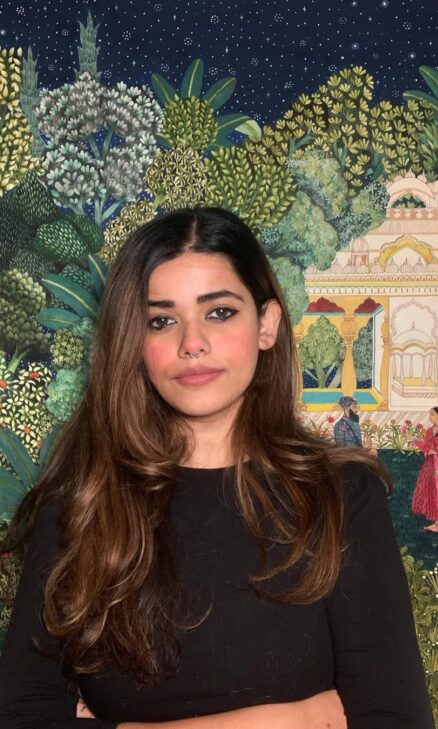
Sukanya Ayde is an illustrator whose work draws from Indian miniature painting traditions to create immersive, nature-led compositions rooted in memory and mood. Working with gouache, watercolour, and natural pigments, she gently reimagines historical visual languages through a contemporary lens.
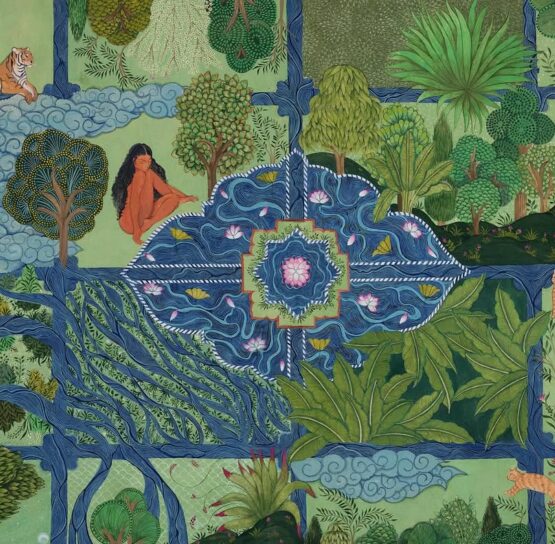
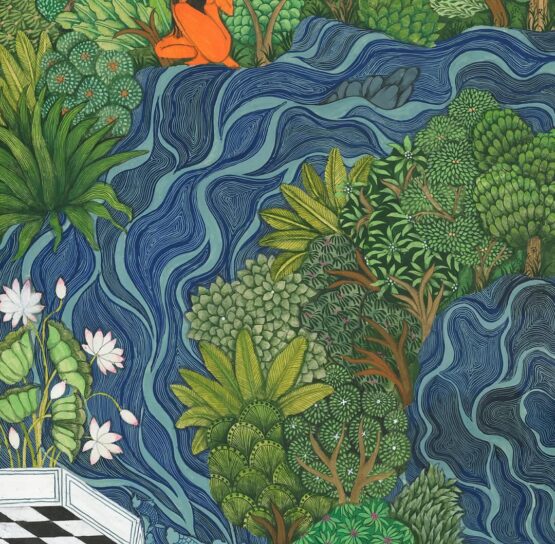
Soft washes of green, ochre, and muted florals unfold across Sukanya Ayde’s paintings like landscapes that exist as traces in memory, echoing miniature painting traditions. Each work carries a finesse, layered with detail, where every motif, leaf, and character is not meant to be read as a literal moment or narrative scene, but as an experience or mood. Nature—particularly dense forests breathing into arched pergolas, flowering creepers reclaiming forgotten spaces, and an evening sky dusted with stars—emerges as the defining trope throughout her work, alongside sentient figures that inhabit these worlds. Rendered with deep reverence, these paintings draw attention to an art form that dates back over a thousand years in the country, while simultaneously reinterpreting it through the lens of a contemporary artist. Born and raised in Delhi, Sukanya's visual language has been shaped by frequent childhood travels across Rajasthan, which exposed her early to the region’s textiles, block prints, and unspoiled landscapes. Before fully committing to art, Sukanya studied History, a foundation that continues to inform her research-driven and contextual approach. This academic grounding eventually gave way to a more tactile mode of expression when she pursued Fashion and Textile Design at the Fashion Institute of Technology, New York, a turning point that allowed her ideas to take visual form. What stands out most, as a viewer, is the way Sukanya’s works earns it’s attention through detail. Drawing deeply from Indian miniature painting traditions, particularly the Mughal-influenced Kota and Bundi schools of Rajasthan, she adopts their nuanced handling of nature, composition, and ornamentation while translating them into a contemporary visual vocabulary. Motifs repeat, patterns breathe, and nature is never decorative but central, treated as both subject and philosophy. The artist’s preferred mediums, gouache, watercolour, and natural pigments, further reinforce this intimacy. Her process is intuitive and meditative, shaped by observation and immersion rather than rigid planning. Landscapes emerge not as literal depictions but as emotional terrains, offering refuge, reflection, and quiet resistance to speed. Currently represented by Mumbai-based gallery Art & Charlie, Sukanya has exhibited in New York at High Line Nine Gallery and across solo and group shows in India. Her collaboration with Hermès for window displays at Jio Plaza further signals the adaptability and relevance of her visual language. In the evolving landscape of contemporary Indian art, Sukanya Ayde occupies a thoughtful middle ground, where tradition is neither preserved nor disrupted, but gently reimagined. Her work adds to a growing movement of homegrown artists who prioritise slowness, memory, and material sensitivity, proving that innovation can be rooted, quiet, and deeply personal.
Sukanya speaks to Blur The Border :
Blur : You come from a background in history, following which you pursued Fashion and Textile Design—what made you take the leap and pursue art?
Sukanya : I’ve been drawn to art for as long as I can remember. As a child, museums and visual culture fascinated me, and art history was always something I instinctively gravitated towards. Studying history helped me understand context, narrative, and how meaning is constructed over time, while fashion and textile design allowed me to work more tangibly with material, form, and process.Over time, I realised that painting was the most direct and honest way for me to bring all of these interests together. Art was always present in my life in one form or another, but it took a few years of exploration to fully commit to it.
Blur : How has your artistic style evolved over the years?
Sukanya : My practice began through textiles, where I explored painting through prints and surface design, working with different kinds of patterns and compositions. When I first started painting independently, my approach was more observational and cautious—I focused on aesthetics and stayed within a safer visual language.Over time, my work has become more personal and direct. I’m less concerned with making something purely beautiful and more interested in using painting to reflect the ideas, conflicts, and questions I find myself engaging with. The work now feels more honest to how I think and experience the world.
Blur : Your training in Fashion and Textile Design at the Fashion Institute of Technology, New York, exposed you to a very different cultural and creative ecosystem. How did this global education influence the way you now engage with traditional Indian art forms?
Sukanya : Studying, living and working in New York exposed me to a very diverse cultural environment and made me more aware of how different visual traditions can coexist and influence one another. Being in that space also made me more conscious of my own background. I’ve always had an affinity for classical and traditional Indian art forms, but the distance helped me look at them with fresh eyes rather than through nostalgia. My global education didn’t replace my relationship with Indian visual traditions—it gave me a broader framework within which to return to them more thoughtfully.
Blur : You draw inspiration from Indian art schools such as Kota and Bundi, particularly in their representation of nature. What aspects of these traditions resonate most strongly with you, making them a significant part of your artworks?
Sukanya : What draws me most to the Kota and Bundi schools is their treatment of nature—particularly the way trees and plant forms are built through strong silhouettes and layered density. Both traditions depict nature as lush and immersive, with a clear attention to distinguishing different types of trees rather than reducing foliage to a single mass.The trees in these paintings bring a sense of life and movement to the composition. Nature in this form feels calm and expansive, and it invites the viewer to slow down and look more closely. In everyday life, we often overlook trees and their silhouettes, but when they are rendered with such intention, they become central and absorbing. I’m also drawn to the colour sensibility of these schools, especially the use of deep blues contrasted with nuanced greens, which adds depth and atmosphere to the work.
Blur : What role does the environment play in your work or in fueling your creativity?
Sukanya : The environment plays an important role in my work, particularly natural spaces. I’m interested in how elements like trees, foliage, and landscape create a sense of presence and rhythm within a composition. Nature has a calming quality, and when observed closely, it offers visual structures—silhouettes, density, and layers—that are often overlooked in everyday life.Engaging with the environment allows me to slow down and notice these details, which then inform how I build space and atmosphere in my paintings. It becomes less about direct representation and more about translating that sense of immersion and quiet intensity into the work.
Blur : Do you have a definitive process while creating? Are there any habits or rituals that help you get into a creative mindset?
Sukanya :I don’t follow a rigid process, but there are certain habits that consistently support my practice. I keep a sketchbook with me at all times, as ideas often surface unexpectedly. When they do, I make quick sketches and write short notes, which helps me return to the idea later and develop it more clearly. Once I’m ready to begin, I spend time visualising the work before putting it down on paper. Earlier in my practice, I planned my colour palettes digitally, but now I prefer a more intuitive approach. I like to keep an open channel between my thoughts, emotions, and the painting itself, allowing the colours to emerge in response to the concept rather than being fixed in advance. Music and atmosphere also play an important role. Listening to Indian classical music and using essential oils helps me settle into a focused, receptive state, which makes it easier to begin and stay present while working.
Blur : With the art world becoming increasingly digital, how do you view the importance of having an online presence today? Has this shift changed the way you approach visibility and community-building as an artist rooted in traditional practices?
Sukanya : Having an online presence is increasingly important today. It has allowed my work to reach a much wider audience and has helped me connect with people across different geographies. In that sense, it plays a key role in visibility and in creating opportunities for dialogue around the work. While my practice itself remains rooted in traditional, material processes, the digital space has changed how I think about visibility and community. It has made the art world feel more accessible and interconnected, allowing artists to engage with peers, collectors, and audiences both locally and globally. I see it as a tool that supports the work rather than something that defines or alters how the work is made.
Blur : If you were to collaborate with another artist, within or outside of your discipline, what is one collaboration you would love to explore?
Sukanya : My experience working with Hermès gave me the opportunity to visualise my work in three dimensions, which opened up an entirely new way of thinking about form and space. That experience made me realise how much potential there is for my practice to expand beyond painting. I would love to explore collaborations with sculptors, as working in 3D would allow my ideas to take on a more physical presence. Translating my visual language into sculptural form feels like a natural extension of my work, and collaborating with someone experienced in that medium would be an exciting way to explore those possibilities more deeply.
Blur : In a moment of rapid change, what is one question you’re sitting with—or one you think our community needs to reflect on and discuss more openly right now?
Sukanya :One question I keep returning to is why we’ve become so uncomfortable with slowing down. We live in a moment that values speed, efficiency, and constant output, often at the cost of reflection and emotional processing. The pace at which we move leaves very little room to pause, absorb, or respond to our inner states. My work encourages a slower way of looking—paying attention to details that are easy to overlook. This way of seeing extends beyond art and into everyday life. When we give ourselves time to process and truly observe the environment around us, especially nature, it creates a sense of nourishment and grounding that often gets lost in constant motion.
Know more about Sukanya:
Instagram: @sukanya.ayde.art