
Aranyani Life
Delhi
Within the historic landscape of Sunder Nursery, the Aranyani Pavilion introduces a different kind of gathering space. Set among restored Mughal-era monuments and gardens, the structure brings together ecological restoration, architecture and cultural programming within a single installation.
The pavilion is part of Aranyani Life, founded by Tara Lal. An architect, photographer and conservationist, Lal established Aranyani as both a storytelling platform and a space for active restoration work. Her approach is shaped by years of travelling through forests and natural landscapes, experiences that exposed her to both the beauty of intact ecosystems and the realities of environmental degradation. Aranyani grew from this personal engagement with land, drawing together interests in mythology, ecology, art and traditional knowledge systems. The name itself comes from Aranyani, a forest deity referenced in the Rigveda. Within the project, the reference acts as a symbolic reminder of humanity’s historic relationship with forests and the natural world. Designed by the architecture practice T__M.space, founded by architects Mario Serrano and Tanil Raif, the pavilion takes the form of a spiral pathway that visitors move through gradually. The design encourages a slower pace of movement. As the path curves inward, the structure filters light, frames views of vegetation and shifts the sensory experience of the surrounding landscape. Rather than functioning as a conventional building, the pavilion operates as a spatial installation intended to be walked through and experienced over time.
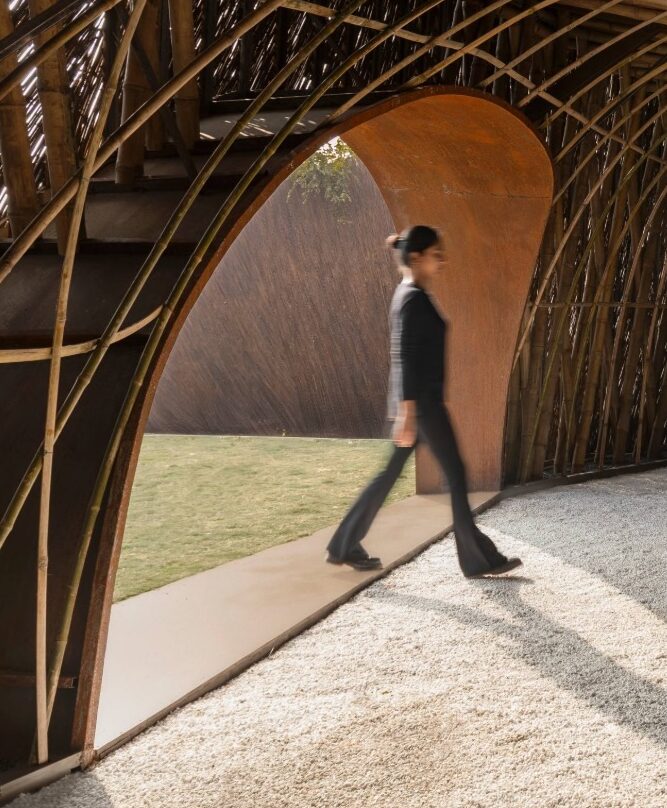
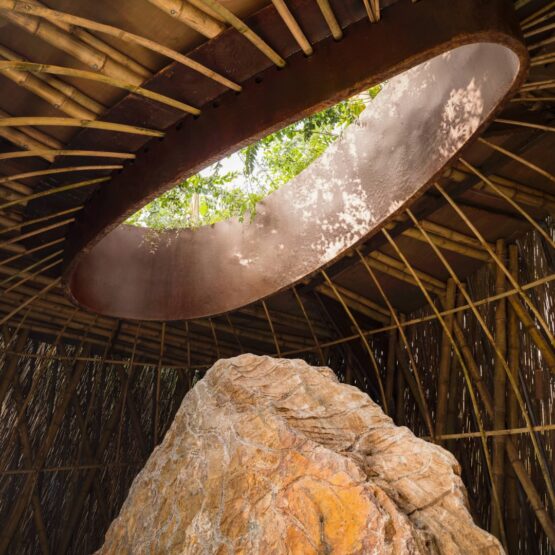
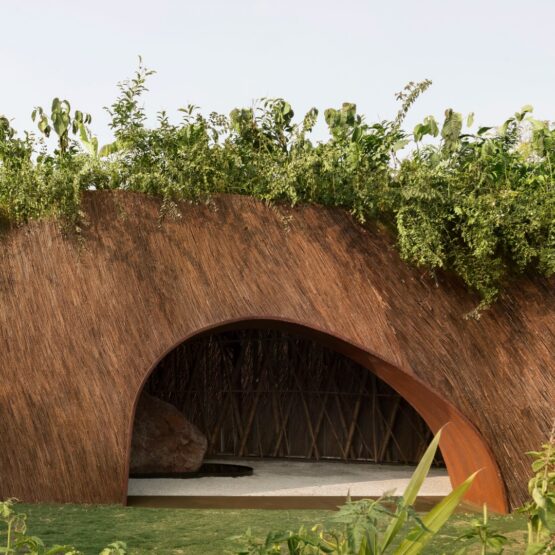
The structure is built using bamboo and reclaimed lantana camara. Lantana, an invasive plant species introduced to India during the colonial period, now spreads widely across forests and is often removed as part of restoration efforts. Here, the plant has been repurposed as a primary construction material, woven across the outer structure. Above it sits a canopy of native plants, creating a layered environment where architecture and landscape interact. At the centre lies the Shrine Gallery, a quiet circular space anchored by a single stone. Reached after following the spiral path inward, the centre acts as a moment of pause within the structure. The gesture is simple, but it reinforces the pavilion’s focus on reflection and awareness of the surrounding environment.
Beyond its architectural presence, the Aranyani Pavilion also functions as a site for public engagement. It hosts conversations, gatherings and cultural programmes that explore ecology, design and traditional knowledge systems. Visitors encounter the structure not only as an installation, but as a place where ideas around land, conservation and cultural memory are shared. In the context of contemporary India, projects that combine ecological restoration with cultural space remain relatively rare. The Aranyani Pavilion stands out for attempting to bridge those worlds. By situating an experimental ecological installation within a historic urban park, it offers a way of thinking about restoration that extends beyond conservation work to how people gather, learn and reconnect with landscapes.
Address: Humayun's Tomb, nizamuddin, National Zoological Park, New Delhi 110013